Tuesday, October 20, 2026 · Ocean Shipping & Ports
What the Lunar Society’s Industrial Approach Says About Supply Chains Today
Noted by Martijn Graat · 453 reads
David Mindell argues that transport, maintenance and process improvements matter as much as automation in building resilient supply chains.
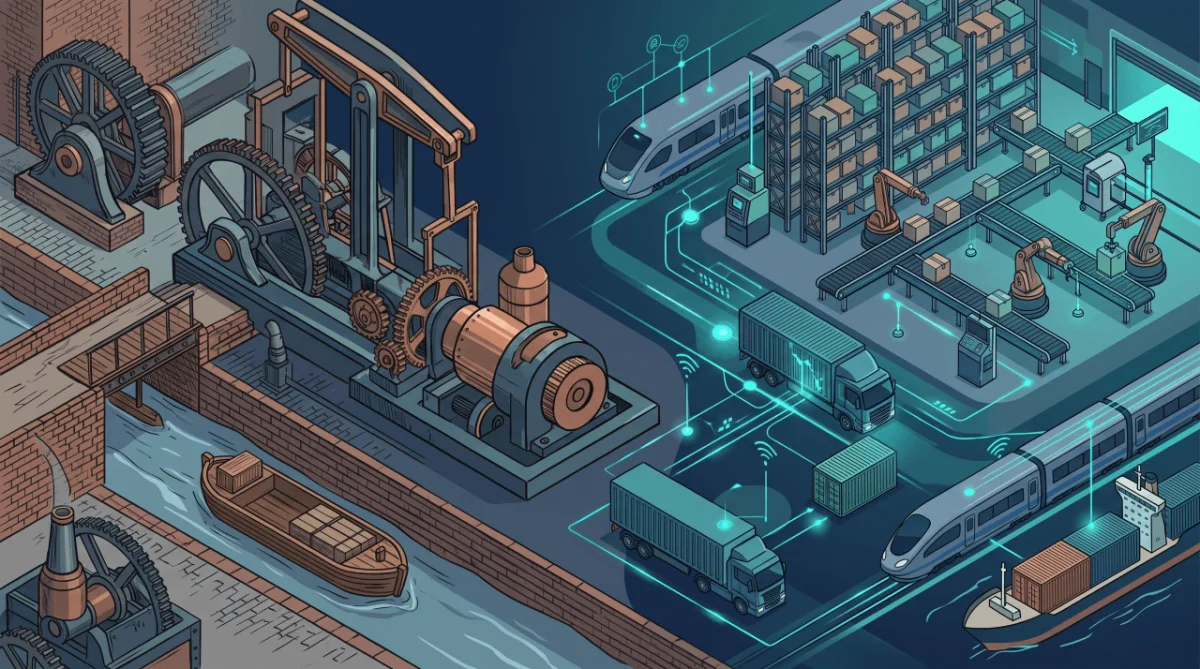
The Lunar Society’s industrial legacy offers a useful reminder for supply chain leaders: new machines matter, but the systems around them determine how much they change. In a conversation with Martijn Graat on the Logistics Matter podcast, David Mindell argues that transportation and process improvements helped drive industrial growth—and that today’s focus on artificial intelligence and automation can distract from the work of making, moving and maintaining goods better.
Innovation meant building connected systems
The Lunar Society was a group of 18th-century thinkers who met during full moons to discuss the industrial challenges of their time. Its members included James Watt, Matthew Boulton and Josiah Wedgwood. Their work reached beyond individual inventions: they also helped reshape logistics networks, build canals, transform raw materials and develop new approaches to marketing.
That combination is relevant to modern supply chains because a machine rarely creates value on its own. Its effect depends on the processes that feed it, the transport that connects it to suppliers and customers, and the people who keep it working. A production improvement can be constrained by a slow handoff or a weak link elsewhere in the network. The Lunar Society’s example, as Mindell presents it, puts those connections at the center of industrial progress.
For logistics teams, the practical question is not simply whether a new technology can perform a task. It is how the change fits into the wider operation: what work moves to a machine, what still requires human judgment, and whether the surrounding processes can support higher output. That systems view makes transportation and operating methods part of the innovation itself, rather than afterthoughts to a product launch.
Automation and the work around it
Mindell takes a measured view of physical automation at a time when artificial intelligence and autonomous systems are often discussed in terms of replacing workers. He describes a case in which one person using 10 machines can do the work of 10 people as a productivity gain. But he couples that point with a broader condition: society needs to keep creating industries and jobs that build on human intelligence.
The distinction matters for operators deciding how to assess automation. A machine may change staffing needs for one task, while raising the importance of other work, such as maintaining equipment, coordinating processes or handling exceptions. The podcast’s argument is that productivity should be considered alongside the capacity to create useful work around new industrial capabilities. The source does not prescribe a staffing model; it asks leaders to think beyond the immediate substitution of people for machines.
That perspective can help ground technology decisions in operating needs. Teams can ask whether a proposed system improves a real process, what support it requires and how its performance depends on people and equipment elsewhere in the operation. Those questions keep attention on the result for the whole network, rather than the appeal of a technology in isolation.
Resilience depends on routine operations
The conversation also contrasts enthusiasm for new technology with the less visible work of process innovation. Mindell points to the COVID-19 port congestion crisis and to the untapped value of maintenance and repair as reasons to examine how goods are made, moved and kept in service. The example makes resilience a question of operational health: how well the processes and assets that support freight flows are managed.
Maintenance can be easy to overlook when attention is fixed on new equipment or software. Yet keeping existing assets functional is part of maintaining the capacity to move goods. Repair work and process improvements may not have the profile of a major technology rollout, but they address the day-to-day conditions on which an operation relies. The podcast frames that work as an important part of industrial progress, rather than a separate concern.
Port congestion provides another reason to look across organizational boundaries. A bottleneck in one part of a freight network can affect the movement of goods beyond that location. Mindell’s emphasis on transport and process innovation invites leaders to consider how infrastructure, operating practices and production decisions interact. The available account does not offer a specific congestion remedy; its point is that durable improvement requires attention to the system moving the goods.
A practical test for supply chain leaders
For teams weighing technology against operational improvements, the episode suggests a useful set of questions: Which process needs to improve? How will equipment, workers and transport connect after the change? What maintenance will the new system require? And what new work or capabilities will it make possible? Those questions can help organizations evaluate technology in terms of its contribution to the wider operation.
The Lunar Society’s example is not a ready-made blueprint for modern logistics. Its value lies in the breadth of its industrial outlook: invention, transportation, materials and marketing all formed part of the same effort to change how goods were produced and distributed. Mindell’s argument carries that builder mindset into current debates about automation, with a clear reminder that productivity depends on more than acquiring machines.
For supply chain professionals, the takeaway is to pair technology adoption with attention to process, transport, maintenance and the human work surrounding new systems. The next improvement may come from a new machine, a better way to connect existing operations, or both. The full conversation between Martijn Graat and David Mindell is available on the Logistics Matter podcast.


