Friday, November 21, 2025 · Trucking & Freight
Delta-Aeromexico Joint Venture Gets Temporary Reprieve in Appeals Court
Noted by Steven Don · 777 reads
An appeals court has paused the planned Delta-Aeromexico JV shutdown, leaving joint pricing and capacity coordination in place while judicial review continues.
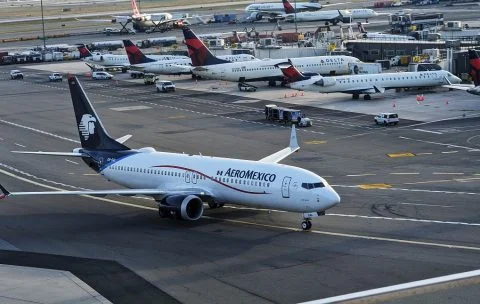
The planned breakup of Delta Air Lines and Aeromexico’s joint venture is on hold, leaving their coordinated US-Mexico operations in place while a legal review proceeds. The Eleventh Circuit Court of Appeals temporarily halted a September 15 Department of Transportation directive that would have required the carriers to unwind the nearly nine-year partnership by January 1, 2026.
The pause does not settle the dispute or determine the JV’s long-term status. It suspends the directive’s effect while the court considers the airlines’ challenge. Aeromexico said the directive is “stayed pending resolution of the judicial review.” For now, the carriers have relief from the scheduled shutdown, but the eventual outcome remains uncertain.
What the directive would have changed
Delta and Aeromexico coordinate on flights between the United States and Mexico under a Joint Cooperation Agreement. The department’s September action would have withdrawn its approval of that agreement and ended the antitrust immunity that allows the airlines to coordinate on competitively sensitive matters.
Under the proposed wind-down, the carriers would have had to stop activities such as common pricing, capacity management and revenue sharing. The department said they could still cooperate through arrangements it described as arms-length, including codesharing, marketing and frequent-flyer programs. The court’s temporary halt puts that timetable and the distinction between permitted and prohibited coordination in question while the review continues.
The airlines went to court to block the directive. Their challenge followed a series of US actions concerning Mexico’s aviation market and the 2015 US-Mexico Air Transport Agreement. The dispute reaches beyond the JV: it also concerns airport access and the way cargo and passenger capacity is distributed between the two countries.
Airport changes sit at the center of the dispute
In July, US authorities imposed restrictions on Mexican passenger and cargo operations, citing concerns about compliance with the 2015 agreement and competition. A central issue is Mexico’s requirement that cargo operations move from Benito Juarez International Airport, or Mexico City International Airport (MEX), to Felipe Angeles International Airport (AFIA).
The relocation was intended to ease congestion at MEX. IATA and the transportation department criticized the move, with the department arguing that it disrupted the market. It said US all-cargo carriers were forced out of MEX in 2023 with 108 business days’ advance notice and that their operating rights under the bilateral agreement had not been restored.
That cargo dispute provides the backdrop to the JV action. The transportation department argued that Mexico’s treatment of US carriers gave Delta and Aeromexico an unfair advantage. It said the airlines’ joint pricing and capacity decisions had received conditional approval, and that Mexico’s conduct altered the competitive conditions under which that approval had been granted.
Those are the department’s stated grounds for seeking an end to the JV’s immunity. The court’s pause means the directive cannot yet force the airlines to stop the covered activities by the January deadline. It does not, by itself, resolve the underlying disagreement over airport access or the carriers’ rights under the air transport agreement.
Cargo capacity remains a separate pressure point
The dispute is unfolding as air cargo operators watch capacity on routes between the two countries. The Airforwarders Association warned earlier this month that the removal of 13 routes operated by Mexican airlines could reduce cargo capacity and disrupt supply chains. Sean Duffy announced in late October that several Mexican carriers would be prevented from operating passenger flights into the United States, removing space in aircraft bellyholds that can carry freight.
Brandon Fried, the association’s executive director, said the lost flights would affect cargo as well as passengers. Bellyhold space is part of the available air freight capacity on passenger services, so a reduction in flights can narrow shipping options even when dedicated freighters continue to operate. The source does not quantify the cargo capacity tied to the 13 routes or specify which shipments would be most affected.
The temporary halt to the Delta-Aeromexico directive and the removal of passenger routes are distinct developments, but both affect the operating environment for cross-border air freight. For shippers and forwarders, the immediate planning question is whether the court’s pause will hold through the review and whether the wider route changes will constrain bellyhold availability. The next concrete marker is the court’s resolution of the airlines’ challenge; until then, the planned January wind-down is suspended.
Read about the September directive targeting the Delta-Aeromexico JV.
Details on the air cargo restrictions affecting Mexico.
The Airforwarders Association’s warning on potential capacity losses.
===END===

