Tuesday, October 6, 2026 · Trucking & Freight
Freight Forwarding Software: 10 Capabilities That Connect Operations
Noted by Team Logi-Sys · 713 reads
Shipment control, automation, visibility and connected finance are among the capabilities that can help forwarders reduce manual work.
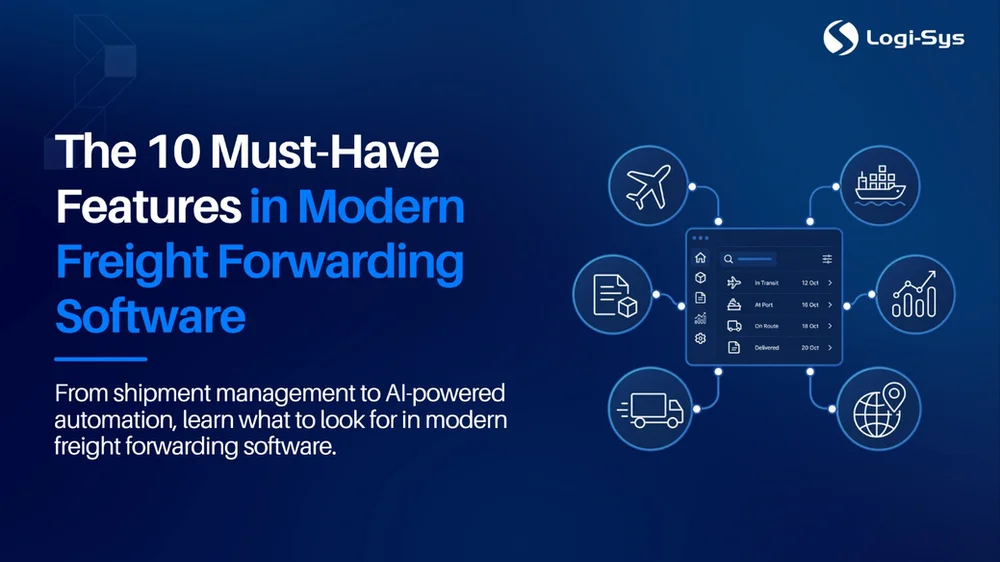
For freight forwarders, software earns its place when it reduces the work involved in coordinating a shipment across teams, partners and systems. A single move can generate bookings, transport updates, documents, customer questions and charges. When those details sit in email, spreadsheets and separate applications, staff must repeatedly transfer information and reconcile different versions.
A connected platform can bring shipment execution, customer management, finance and reporting into one working environment. The practical test is whether information follows the shipment from quotation through delivery and invoicing, while reducing routine tasks and giving teams a clearer view of exceptions.
Manage the shipment from quote to invoice
Core freight software should support the full shipment lifecycle: quotation, booking, documentation, execution, delivery and billing. It should handle air, ocean and road freight, as well as multimodal moves, imports, exports, consolidations and deconsolidations. Teams need one shipment record that shows its progress without requiring them to search across several tools.
That record becomes more useful when sales and operations share customer and rate information. A connected customer relationship management system can track leads, opportunities, customer and prospect profiles, quotations, rates, follow-ups and activity history. When a quote turns into a job, the relevant details can pass to operations directly, reducing the chance that key information disappears in the handover.
Cut document handling and manual transfers
Freight moves rely on invoices, packing lists, bills of lading, airway bills, delivery orders, certificates and other paperwork. Software can help generate these documents from templates, fill fields with existing shipment data, store files, track versions and share documents digitally. Document extraction can also capture information from incoming paperwork and reduce rekeying.
Those functions are most useful when they connect to the rest of the workflow. A document’s data should be available to the teams and processes that need it, instead of being copied manually between records. Automation can also support email classification, data validation and routine workflow steps. The relevant question for a forwarder is which recurring tasks the system can take off employees’ desks.
Connections beyond the forwarder’s own operation matter too. Potential integration points include airlines, shipping lines, carrier APIs and EDI, customs systems, agents, warehouses, accounting applications, payment platforms, customer portals and third-party logistics systems. More direct exchanges can reduce manual transfers and help partners work from consistent shipment information.
Give customers and operators clearer visibility
Customers want shipment updates without having to contact an operations desk for every status check. A platform can present shipment status, milestones, estimated arrival information, vessel or flight details, container tracking, delivery status and exception alerts. Customer portals let users access relevant updates themselves, which can reduce routine status requests and improve transparency.
Visibility also matters inside the business. When teams can see where a shipment is in its journey and identify exceptions, they have a clearer starting point for responding to delays or customer questions. The source describes real-time or near-real-time visibility as a capability to seek; it does not specify a particular update frequency or tracking data provider.
Connect shipment activity to financial control
Operational and financial records are closely linked, but they may be managed in separate systems. Software that brings the workflows together can support automated billing, customer invoices, vendor invoices, cost management, credit control, accounts receivable and accounts payable. Multi-currency support and financial reporting are also relevant capabilities for forwarders handling international work.
Linking charges and costs to shipment activity gives managers a clearer view of revenue, margins and unpaid balances. It can also help identify missed charges or delayed billing. Profitability analysis is more useful when it draws on connected operational and financial information rather than requiring teams to assemble it from separate files.
Support compliance work and business decisions
Requirements for international shipments can vary by market, commodity, shipment type and transport mode. Depending on the business and its markets, software may support customs filing, regulatory documents, trade compliance, duty and tax information, electronic data exchange, audit trails and compliance reporting. For operations across multiple markets, connections to relevant local systems can matter.
Reporting should help users interpret business activity, not simply store it. Dashboards can cover shipment volumes, revenue, gross profit, customer, lane and carrier performance, the sales pipeline, outstanding receivables, operational productivity and shipment exceptions. With that information available directly, managers can examine which customers and services are profitable, where lanes are growing and where operational delays are occurring.
Make automation and usability practical
AI and automation can be applied to specific tasks, including extracting document data, processing shipment details, classifying email, validating information, detecting exceptions and triggering workflows. A document reader, for example, may extract fields from paperwork and enter them into the relevant records. Other functions listed in the source include customer support, operational recommendations and predictive insights. Their value depends on how well they address real, repeatable work in the forwarder’s operation.
Employees and customers also need a usable interface. Web access, mobile accessibility, clear dashboards, self-service portals, role-based permissions, alerts, search, configurable workflows and straightforward reporting can make the system easier to use. Even a capable platform has limited value if staff find it difficult to learn or rely on workarounds.
Choose for the operation you have
Requirements differ by company. A smaller forwarder may prioritize implementation effort and cost, while a larger organization may need integrations, multiple-entity management, financial controls and support for different markets. Buyers can assess a platform by asking whether it connects sales, operations, finance and documentation; removes repetitive work; accommodates growth in customers, shipments, staff, locations and lanes; makes shipment information accessible to customers; and turns operating data into useful decisions.
The shift is from disconnected tasks to linked workflows: quote to booking, booking to shipment, shipment to delivery and delivery to invoice. The strongest fit is a system that connects those stages, provides visibility across them and reduces the effort required to keep information aligned. Feature lists are a starting point; the more useful measure is how much operational complexity the platform removes.


