Friday, August 28, 2026 · Trucking & Freight
Clean Data Sets the Limits for AI in Logistics
Noted by Team Logi-Sys · 627 reads
AI can improve forecasting and workflow automation, but disconnected, incomplete or duplicated shipment data can undermine its results.
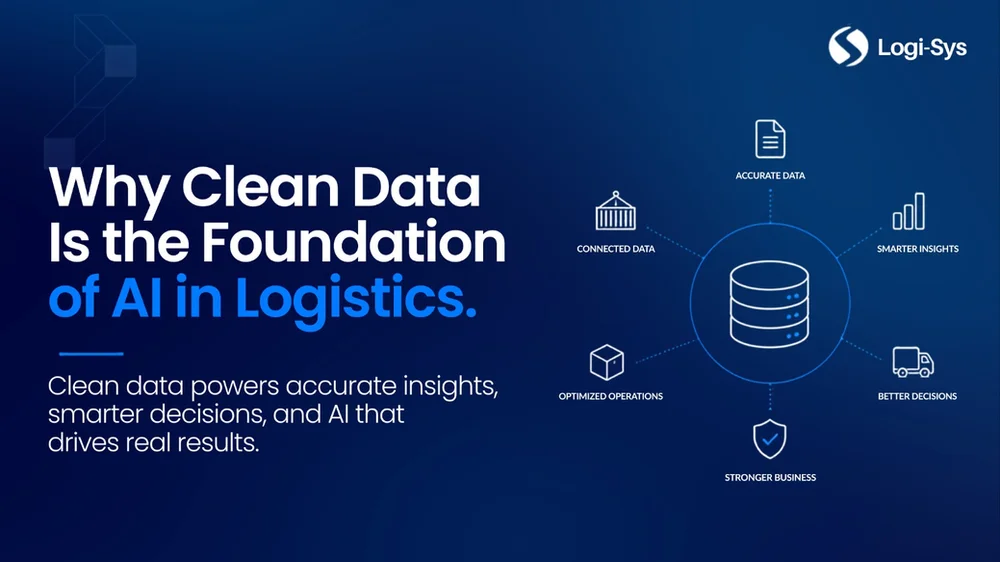
For logistics teams considering AI, the first operational question is whether the information feeding it can be trusted. Predicting shipment delays, processing documents and automating routine work all depend on data that is accurate, consistent and accessible. When records are scattered across spreadsheets, email, separate applications and external portals, buying an AI tool won’t resolve the underlying gaps.
That makes data quality a practical prerequisite for useful automation and analysis. An AI system can process information quickly, but incomplete shipment details, conflicting statuses or duplicate customer records can still produce unreliable results. Errors may show up as flawed predictions, misleading reports, failed workflows or decisions based on the wrong version of a record.
One shipment, many records
A shipment can generate customer details, references, rates, carrier information, invoices, customs data, tracking events, payment records and delivery updates. Different departments may manage those details in different systems: operations in one application, finance in another, sales in spreadsheets, and customer service through email. Carrier updates may arrive through portals or integrations, while employees manually transfer information between tools.
Each handoff creates a chance for an error. A missing field or mistyped reference can pass through several processes before anyone catches it. By the time the discrepancy appears in a report or reaches an AI model, tracing it back to its source may be difficult.
Disconnected applications can also keep separate versions of the same information. If a customer changes a billing address in a customer management system but finance retains the old address, an invoice may be generated with outdated details. The invoice is where the problem becomes visible; the mismatch began when the two systems stopped reflecting the same record.
Similar inconsistencies can affect customer names, shipment references, carrier details, rates, currencies, locations and status codes. Unless systems share information effectively and records are governed consistently, an AI tool may have no reliable basis for deciding which version to use.
Small inconsistencies carry operational costs
Duplicates can look harmless: a customer appears twice, a shipment is entered more than once, or a carrier’s name varies between systems. But those records can distort billing, reporting, forecasting, customer communication and operational workflows. If an AI system treats two entries for the same customer as separate accounts, its analysis may misstate customer activity, revenue, segmentation or expected demand.
Manual entry adds another source of friction. Staff copy details from email into spreadsheets, download documents and retype information, update shipment statuses, and reconcile records across applications. Each task may be brief, but repeating it across many shipments takes time and creates more opportunities for mistakes.
The cost also includes the attention of experienced employees. Time spent moving and checking information is time unavailable for resolving exceptions, helping customers or making operational decisions. Reducing unnecessary re-entry can therefore improve both data reliability and how teams use their expertise.
Automation needs consistent inputs
Consider a workflow that sends a customer a notification when a shipment reaches a specified milestone. It depends on a recognizable status and a matching shipment number. If the status is missing, recorded differently across systems or attached to the wrong reference, the workflow could fail, trigger the wrong action or send inaccurate information.
Standardized, dependable records give automated processes a clearer basis for acting. Data quality and automation are therefore closely linked: better information supports more consistent workflows, and consistent workflows can help maintain better information. Automating a process without addressing its input problems can carry those problems through faster.
Check the data before choosing an AI tool
Before selecting a solution, logistics businesses can assess five aspects of the information they rely on:
- Accuracy: Are customer details, shipment values, rates, locations and statuses correct?
- Consistency: Do names, reference numbers, currencies, locations and shipment statuses use standardized formats across systems?
- Completeness: Are important fields missing, leaving too little context for useful analysis or predictions?
- Accessibility: Can the relevant teams and applications reach the information they need, or is it locked in disconnected tools?
- Duplication: Do multiple records represent the same customer, shipment, transaction or other business entity?
These checks make readiness a process question as much as a technology question. A sophisticated model cannot make inaccessible information available by itself, or reliably resolve conflicting records without a sound basis for doing so.
Connect information across the shipment process
For a freight forwarder, useful data flows may connect sales, operations, documentation, customs, tracking, billing, finance and customer service. When those processes share information, staff have less need to recreate or re-enter the same details at each stage. A shipment recorded once can then support several workflows.
The priority is not simply to add another dashboard or collect more information. Logistics businesses already generate data across daily work. The task is to make that information accurate, connected, accessible and usable. Teams can start by identifying where poor data flows cause the most friction, such as spreadsheet-dependent work, repeated reconciliation, manual document processing or separate operational and financial records.
Improving those flows can also create a more useful base for AI applications such as document processing, pattern detection, delay prediction, routine communications and faster information retrieval. The value of those applications depends on the records they receive. More data alone does not guarantee better results.
Start with the operational problem
Becoming ready for AI doesn’t require changing every process at once. A practical first step is to find recurring data problems and address them where they disrupt work: duplicate customer records, inconsistent shipment details, disconnected systems or repeated manual entry. From there, teams can improve how information is captured, standardized and shared.
The objective is to create reliable data flows that support automation and give employees useful information for decisions. When a company has that foundation, AI has a better chance of identifying patterns, processing documents and supporting day-to-day work as intended. For logistics operators, the quality of the data underneath the tool will shape how much the tool can contribute.


