Wednesday, April 22, 2026 · Trucking & Freight
FCL vs. LCL Shipping: Costs, Transit Times and Handling Risks
Noted by a Guest Author · 306 reads
FCL suits larger, urgent or sensitive loads; LCL can lower costs for smaller shipments. Compare quotes around the 12–20 CBM break-even range.
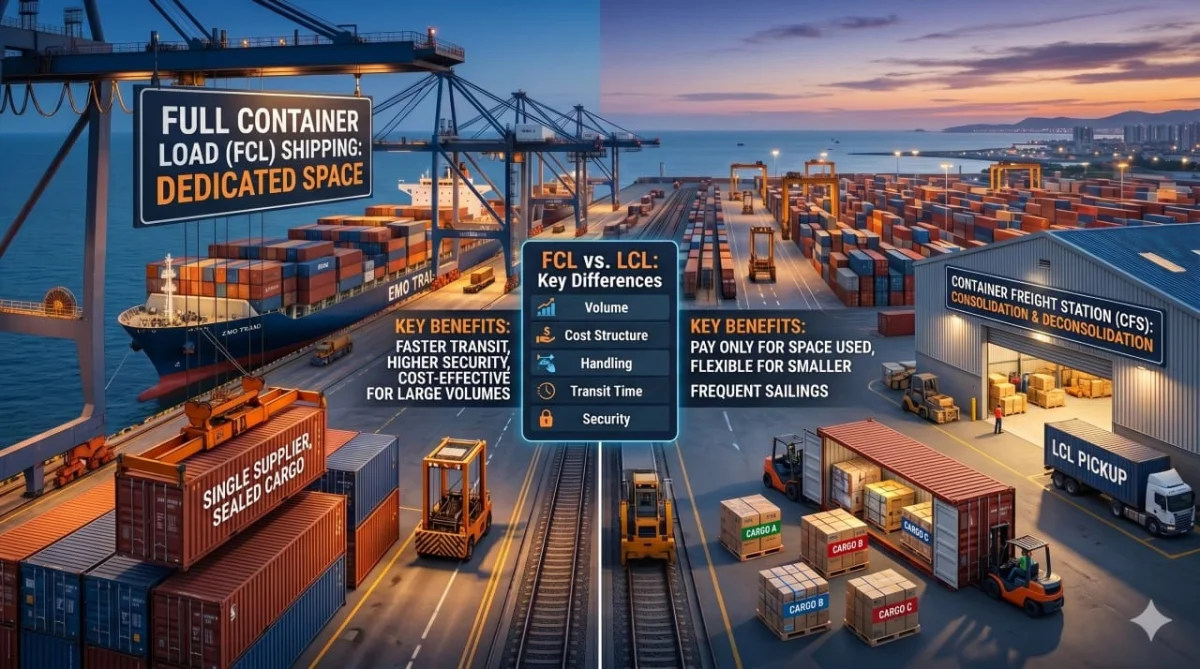
Choosing between full container load (FCL) and less than container load (LCL) affects more than how much space a shipment uses. The choice changes how cargo moves through freight facilities, how often it is handled and how the bill is calculated. For shippers, the useful comparison starts with shipment volume, then accounts for timing, cargo sensitivity and the route.
How the two services move cargo
With FCL, one shipper’s cargo occupies a container that is sealed after loading and stays closed until it reaches its destination. The shipment avoids the consolidation and sorting stages that come with shared-container service. FCL can therefore suit large loads, or freight that benefits from fewer handling points, even when the container isn’t completely full.
LCL combines a shipper’s cargo with freight from other customers. At the origin, the shipment goes to a container freight station (CFS), where it is grouped with other cargo before the container travels by sea. At the destination, a CFS separates the shipments for onward delivery. The customer pays for the portion of container space used, rather than reserving the whole container.
That shared movement can make LCL a practical fit for smaller consignments. It also adds steps: freight must be received, consolidated, separated and released at the relevant facilities. Those stages affect planning as well as cost, especially when delivery timing is tight.
Transit time depends on the route and service stages
FCL avoids the time needed to consolidate multiple shipments at origin and sort them at destination, so it can reduce handling time. LCL schedules must allow for those operations, which can add several days. The difference depends on the route, facility schedules and conditions during transit.
The source reports average port-to-port transit ranges of 14 to 39 days for LCL and 23 to 42 days for FCL on major trade lanes, citing SeaRates. These ranges overlap, and the figures alone don’t establish that one service will always be faster. They are port-to-port estimates; door-to-door movement takes longer when pickup, delivery, consolidation or deconsolidation is included.
For a time-sensitive shipment, compare the full service timeline for the specific lane rather than relying on a general range. An FCL booking may avoid CFS processing, while the sailing schedule and other route conditions still shape the overall transit time. LCL can work when the delivery window has room for its additional handling stages.
Compare total cost against shipment volume
FCL charges cover the container, including space that may remain unused. That fixed cost becomes more attractive as the cargo fills more of the available capacity. LCL pricing is tied to the space occupied, which can make it less expensive for smaller loads but less compelling once volume approaches the cost of booking a full container.
The break-even point is the shipment volume at which the total cost of FCL becomes comparable to, or lower than, LCL. The source describes an estimate of around 12 to 15 cubic meters (CBM) as a longstanding reference, while noting that many freight forwarders now use 15 to 20 CBM as a typical threshold. It also cites a general rule that shipments below 13 CBM often suit LCL. These are planning guides, not fixed price boundaries: the route, season and surcharges can change the comparison.
For shipments near the middle of that range, get quotes for both options using the same origin, destination and service requirements. Compare the total charges and delivery timelines, not only the base price or rate per unit of volume. The source cites an earlier break-even estimate and notes that actual pricing varies.
Handling and cargo needs matter
A sealed FCL container has fewer cargo handling points after loading, which can reduce exposure to damage or loss. That can make FCL a better operational fit for fragile, high-value or sensitive goods. It doesn’t eliminate every transit risk, but the shipment is less exposed to the sorting and transfers required in LCL service.
LCL cargo shares container space with freight from other shippers and passes through freight stations for consolidation and deconsolidation. Each additional movement creates another opportunity for damage or loss. For routine cargo that can tolerate standard handling, the lower cost of sharing space may still make sense; for sensitive freight, the added handling deserves weight in the decision.
Use consolidation and mixed strategies where they fit
Buyer’s consolidation brings shipments from multiple suppliers together in one FCL container. It can help a buyer combine smaller orders, use container capacity more fully and avoid having those shipments separated until the container reaches its destination. It works best when the shipments can be coordinated for a shared destination and delivery plan.
Shippers can also use both services across their freight plans. Smaller or specialized orders may move as LCL, while larger, denser or urgent loads move as FCL. Matching the method to each shipment gives teams room to manage inventory and delivery needs without treating every order the same way.
Make the booking decision shipment by shipment
FCL is generally the stronger candidate when volume is high, delivery timing is tight or cargo benefits from fewer handling points. LCL often fits smaller loads where sharing container space brings a cost advantage and the schedule can absorb CFS processing. Neither method is automatically the best choice for every shipment.
Start with CBM, then compare current quotes and door-to-door timelines for the relevant lane. Around 12 to 20 CBM, the decision can turn on route and seasonal pricing, so checking both services is useful. The source also describes LCL pricing as more cost-effective for smaller consignments, with FCL making more sense as shipment volume grows.
The practical takeaway is to assess space, time and handling together. A low LCL rate may not settle the question if the extra processing conflicts with the delivery window; a partly empty FCL container may still be justified when cargo volume or handling needs support it.


