Friday, June 26, 2026 · Supply Chain Tech
DHL eCommerce Uses AI to Speed Contract Reviews and Customer Case Research
Noted by Krishna Natarajan · 323 reads
DHL eCommerce says AI cuts customer case research from four to six hours to two to five minutes and supports faster contract reviews.
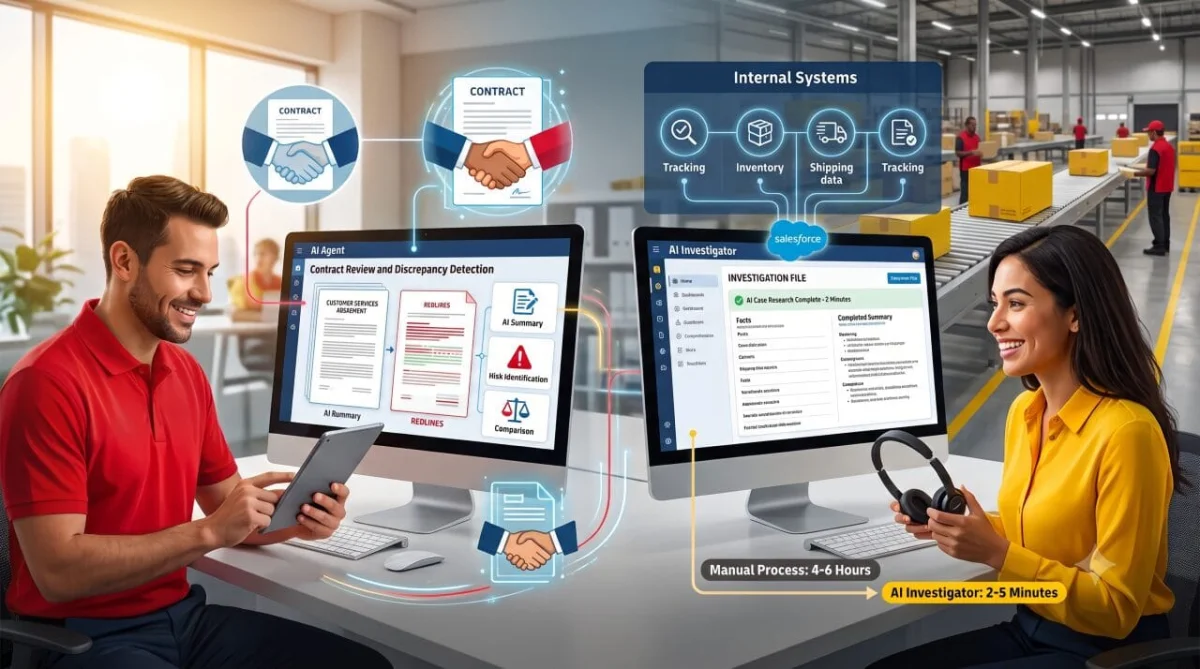
DHL eCommerce Americas is applying AI to two time consuming workflows: reviewing customer service agreements and researching customer inquiries. The company says its digital investigator reduces case research from four to six hours to two to five minutes. A separate tool helps analysts compare contract language, while people retain responsibility for decisions and customer communication.
The examples show where DHL eCommerce is putting AI to work: behind the scenes, on tasks that require collecting and comparing information. That focus matters operationally. Contract reviews can hold up the start of a customer relationship, while gathering details across internal systems can delay a response to a service case. In both workflows, the software prepares information for employees to assess and act on.
AI supports agreement reviews
Customer agreements set out pricing and expectations for each relationship. Reviewing them involves examining clauses, comparing document versions and working through proposed edits. DHL eCommerce says those manual steps can consume analysts’ time and extend negotiations, even though careful review remains necessary.
In early 2026, the company’s Commercial team introduced an AI agent to support reviews of Customer Services Agreements. Analysts upload contracts to the tool, which performs comparison work that previously took hours of human attention. The source describes the tool’s purpose and workflow but does not list the specific checks it runs.
Human analysts remain responsible for judgment and decisions. The AI handles repetitive comparison tasks, helping staff move toward a clean, accurate version of an agreement. That division of work keeps contract review in human hands while reducing time spent on the mechanical parts of the process.
DHL eCommerce links faster review cycles with earlier customer onboarding and more analyst time for strategic work instead of formatting. It also says the tool can catch inconsistencies that might otherwise be missed. The company presents these as benefits of applying AI to an existing process, rather than changing who makes the final call.
For teams handling agreements, the practical test is whether automated comparison makes review faster without obscuring the underlying changes. In DHL eCommerce’s approach, analysts still need to assess the contract and decide how to resolve issues. The tool’s role is to prepare and compare material so that attention can stay on the substance of the agreement.
Case research falls from hours to minutes
Customer Service is using AI earlier in the process of resolving inquiries. A case can require agents to collect information from several internal systems, verify details and assemble a clear account of what happened. DHL eCommerce says this investigation could take hours before an agent was ready to respond.
In December 2025, the company launched a digital investigator that begins work when a ticket is created in Salesforce. It retrieves data from internal systems, brings relevant facts together and prepares a case file for a Customer Service agent. The reported time for that initial research drops from four to six hours to two to five minutes.
The agent receives a prepared summary and takes over the customer interaction and resolution. That handoff puts the software on information gathering and the employee on the response. DHL eCommerce says the change helps Customer Service resolve cases sooner, gives operations teams fewer delays when issues escalate, and helps customers receive quicker, more accurate answers.
The time comparison concerns the research stage described by the company; it does not establish how long every case takes to resolve from ticket creation through final response. Still, reducing the time needed to assemble case information can give an agent a head start, especially when an inquiry depends on details spread across multiple systems.
A workflow led approach
DHL eCommerce describes a repeatable method behind the two applications: find a process that slows employees down, identify steps that are repetitive, assign suitable tasks to AI, and keep people responsible for decisions and communication. The company says it plans to expand practical uses after they demonstrate value.
One further application in development is a voice agent for consumer inquiries. The source gives no launch date or details about the agent’s capabilities, so the near term operational picture rests on the two uses already described: contract comparison and case research.
Krishna Natarajan leads AI, Innovation and Digital Product Management for DHL eCommerce Americas. His role covers AI initiatives intended to address operational and customer challenges and move from experimentation to wider use.
For shippers and service teams, the examples offer a concrete view of where AI can fit into logistics work: preparing information that employees already need to review. DHL eCommerce’s reported case research time shows the clearest measurable change; contract review is described in terms of faster cycles and more consistent comparisons, without a specific time saving. The next measure to watch is how these tools perform as the company extends them to more workflows.
Krishna Natarajan leads AI, Innovation and Digital Product Management for DHL eCommerce Americas.


