Tuesday, January 20, 2026 · Supply Chain Tech
Shared Courier Routes Could Cut Delivery Costs and Empty Miles
Noted by Edward Spence · 740 reads
Matching parcels to couriers already travelling nearby could lower delivery costs, improve driver earnings and make resale and reuse easier.
Home » Shared courier routes could cut delivery costs and empty miles
Courier networks face a utilization problem: delivery demand is growing, but many vans still carry spare capacity or return empty after a drop. A shared-route model aims to make those miles productive by matching shipments with professional couriers already travelling in the right direction. The potential gains reach customers, drivers and operators, though they depend on finding suitable routes and coordinating deliveries reliably.
Spare capacity carries a cost
Dedicated trips give operators direct control over a delivery, but a vehicle can still make the journey without using much of its available load space. When each shipment prompts a separate run, overlapping routes and empty return legs add fuel use and operating costs. Customers ultimately bear some of that expense through delivery charges, which can feel out of proportion when the item is bulky or inexpensive.
Pricing can add to the frustration. The source describes customers encountering fuel surcharges, peak-time premiums and other fees late in the booking process. Communication may also be limited once an item is in transit, while service quality varies. Together, unclear costs and poor visibility make it harder for a customer to judge what a delivery will cost or when it will arrive.
Underused capacity affects drivers as well. A courier may spend long hours on the road while having room for another shipment, yet the traditional trip structure can leave that capacity unsold. The problem is not a lack of delivery activity; it is that existing journeys don't always match the goods that need moving.
One-off shipments challenge fixed networks
Online marketplaces and peer-to-peer sales have increased the number of irregular shipments between individuals, according to the source. These jobs are less predictable than steady flows between distribution centres, making them harder to fit into delivery operations built around repeatable routes and planned volumes. At the same time, customers expect flexible service, clear prices and updates as parcels move.
That combination gives shared-route logistics a practical role. Rather than dispatching a vehicle solely for one shipment, a platform can connect the job with a professional courier already travelling along a compatible route. The shipment then uses space on a journey that would have taken place anyway. The approach depends on matching the parcel, timing and destination to an available trip; it does not remove the need to manage handoffs and delivery expectations.
The article claims that aligning deliveries with existing routes can reduce costs by up to 60% and emissions by up to 80%. Those figures are presented as potential outcomes of shared-route models; no calculation method or comparison baseline is given in the source. For operators considering the approach, the central operational question is how often available capacity and delivery requirements line up well enough to produce those savings.
Transparency is part of the service
Better route use can benefit customers through lower, clearer pricing, while drivers may earn additional income by carrying another shipment on a journey they are already making. Operators may also reduce the overhead tied to underused vehicles. The value depends on whether the added delivery can be handled without disrupting the courier's existing work or weakening service reliability.
Shared logistics platforms can also provide upfront prices, real-time progress updates and direct communication between customers and drivers. Ratings and reviews give users another way to assess service. These features address a familiar gap in courier delivery: a customer may know the booking price but have little visibility into progress or accountability once the parcel is on the road. Digital updates can make that part of the process easier to follow, provided the information stays current and customers know whom to contact if plans change.
Reuse depends on affordable delivery
Delivery costs can determine whether a used item is resold, passed on or discarded. The source says billions of pounds' worth of unwanted but usable goods are thrown away or left unsold each year because moving them is too expensive, inconvenient or carbon-intensive. It also cites £1.27 billion in unwanted gifts circulating around Christmas, with some ultimately sent to landfill despite being suitable for reuse or resale.
For these transactions, the delivery charge can outweigh the item's value. A shared journey could make it easier to move a single bulky purchase between private sellers and buyers without arranging a dedicated trip. That may reduce friction in resale and reuse, although the result still depends on a convenient courier route, a workable pickup window and a price that makes sense for both parties.
Edward Spence, CEO and co-founder of Porta, argues that the courier sector should make fuller use of vehicles already on the road. His company operates a delivery platform built around spare vehicle capacity. Spence's perspective comes from a business promoting this model, so the claimed cost and emissions reductions should be read in that context. The broader operational case is clear: if carriers can match more shipments to existing trips, they can put more of each mile to work.
As peer-to-peer commerce produces more scattered, one-off deliveries, route utilization will matter alongside fleet size. The useful measure is whether a system can fill spare space while keeping prices understandable, updates timely and delivery commitments dependable. The lowest-impact trip is often one that can carry another shipment without adding a separate journey.
Edward Spence is the CEO and co-founder of Porta. He co-founded the delivery platform with technology leader Michael Boulter. The company focuses on matching deliveries with spare capacity in vehicles already travelling on the road. Spence previously worked as a management consultant and holds an MBA from INSEAD. The source says the business has expanded nationwide through organic growth, with a focus on transparency, trust and sustainability.
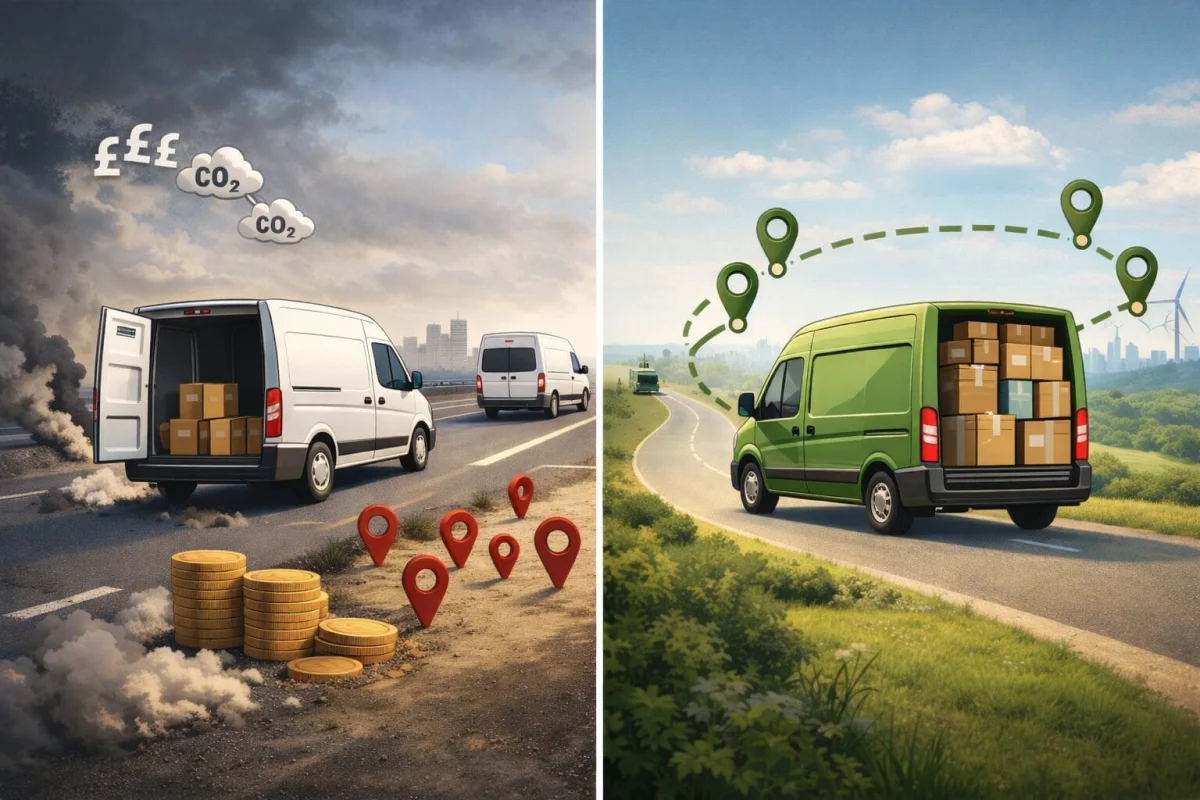
The header image was created by AI, based on the content of the source article.
Marie Baronstraat 11, 3056AA Rotterdam - The Netherlands • CoC: 55851991 • VAT: NL001643631B88 • Website design: Commpany


