Wednesday, September 30, 2026 · Ocean Shipping & Ports
When Exporters Should Decline a USMCA Origin Certification
Noted by [email protected] (David Noah) · 603 reads
Check tariff savings, origin rules and supporting records before certifying. USMCA remains in effect, with annual reviews set to begin in 2027.

A USMCA origin certification carries a responsibility: the claim must be accurate, and the supporting records must be available if the shipment is checked. Exporters should weigh that obligation against the tariff benefit before filling out a customer’s request. If the goods don’t qualify, the origin can’t be verified, or the savings don’t justify the work, declining to certify may be the sounder choice.

USMCA replaced NAFTA on July 1, 2020. It lets qualifying goods traded among the United States, Canada and Mexico receive preferential tariff treatment. The agreement remains in effect after its first joint review, held July 1, 2026. The United States did not agree to extend it for another 16-year term in its current form, but that decision did not end the agreement or its tariff benefits. Under Article 34.7, annual reviews are set to begin in 2027. Unless all three countries later agree to extend the agreement, it is scheduled to expire July 1, 2036.

For now, qualifying goods can still receive preferential treatment under the existing certification requirements. A certificate establishes eligibility for USMCA treatment; it doesn’t guarantee a shipment will receive a financial benefit under every tariff or trade measure. Exporters and importers should keep track of the annual reviews and assess the costs and savings for their products as conditions change.

Five reasons to decline a certification
1. The product already enters duty-free
Some goods may already qualify for a zero duty rate under the Most Favored Nation (MFN) tariff schedule. If so, a USMCA certification may add paperwork without reducing duties. Start with the product’s harmonized code, then check the applicable Canadian and Mexican tariffs. The right comparison is between the duty cost with USMCA treatment and the cost without it.

Eligibility alone doesn’t settle that calculation. Other tariffs or measures may affect a product whether or not it qualifies for USMCA. Recheck the potential savings against the rules applying to the specific shipment before taking on the certification work.
2. You can’t confirm the product qualifies
Signing the certification is a substantive claim, not a routine response to a form request. The person certifying should understand the export and have a sound basis for the information provided. If the company can’t confirm that the product meets the applicable origin rule, it should hold back the certification until it can.

The certifier also needs records to support the claim if it is reviewed. That makes internal information and clear responsibility important: a company should know who checked the product, what information they relied on and where the supporting documents are kept.

3. The records don’t establish origin
Manufacturing a product in the United States doesn’t automatically make it originating under USMCA. The agreement’s rules distinguish where a good was made from whether it meets the requirements for preferential treatment. Exporters need to check the specific rule that applies to the product and retain evidence that supports the origin criterion. See Country of Origin Determination: What U.S. Importers Need to Know for related background.

Supply chains can include materials and production steps from multiple places. If those inputs or processes change, the company may need to reassess whether the finished product still qualifies. A certification shouldn’t rely on an outdated view of how the good is made.
4. The savings don’t cover the administrative effort
Running a certification program takes staff time, training and recordkeeping. Exporters and producers aren’t required to participate, and for some businesses, the work and risk of an unsupported claim may outweigh the possible duty savings. That can be especially true when a product receives little or no tariff benefit.
Review the decision as product costs, sourcing and applicable tariffs change. If the benefit disappears, there may be little reason to keep certifying that product. If the numbers still support participation, an organized process can reduce repeated work and help keep records connected to each claim.
5. The product does not meet the origin rules
If the goods don’t qualify, don’t certify them. A request from a customer doesn’t change the origin criteria, and a certificate can’t make a nonqualifying product eligible. Confirm the rule for the good before preparing the document, and explain that the product doesn’t meet the requirements when that is the result.
What a valid certification must include
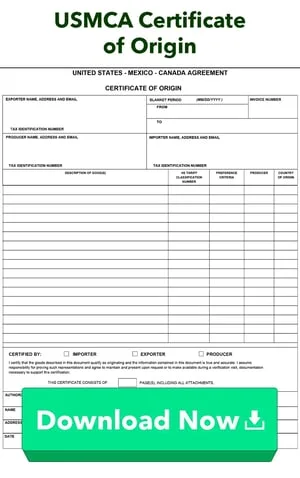
USMCA doesn’t prescribe a single form. The certification can appear on an invoice or another document, and it can be signed electronically. It must still contain nine minimum data elements:
- Whether the certifier is the importer, exporter or producer.
- Certifier information.
- Exporter information.
- Producer information.
- Importer information, if known.
- A product description and its six-digit HS classification.
- The applicable origin criterion.
- The blanket period, if applicable.
- An authorized signature, date and the required certification statement.
One certification may cover a single shipment or multiple shipments of identical goods during a period of up to 12 months. If an exporter or producer later discovers that a certification contains incorrect information, it must promptly notify everyone who received it. That duty is another reason to treat the document as a continuing responsibility, with a process for correcting errors and communicating them.
When the product qualifies and the expected tariff benefit justifies the effort, organized export records can make the work easier. Product details, shipment data and origin evidence can help teams prepare certificates consistently and avoid entering the same information repeatedly. The key is to confirm the product’s eligibility and the shipment’s potential benefit before signing.


