Thursday, August 27, 2026 · Ocean Shipping & Ports
S-991f Sign: How Spain’s Automated Vehicle Spacing Checks Work
Noted by José Miguel Fernández Gómez · 456 reads
Spain’s S-991f sign marks automated checks of following distance; drivers must leave enough room to stop, with penalties typically reaching €200 and four points.
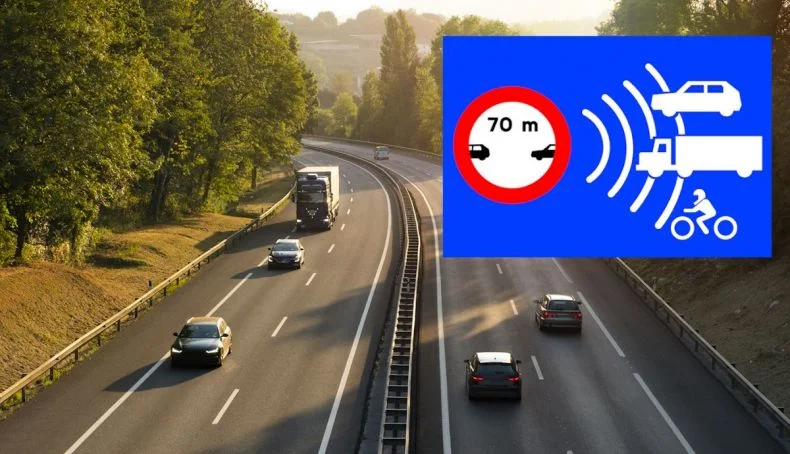
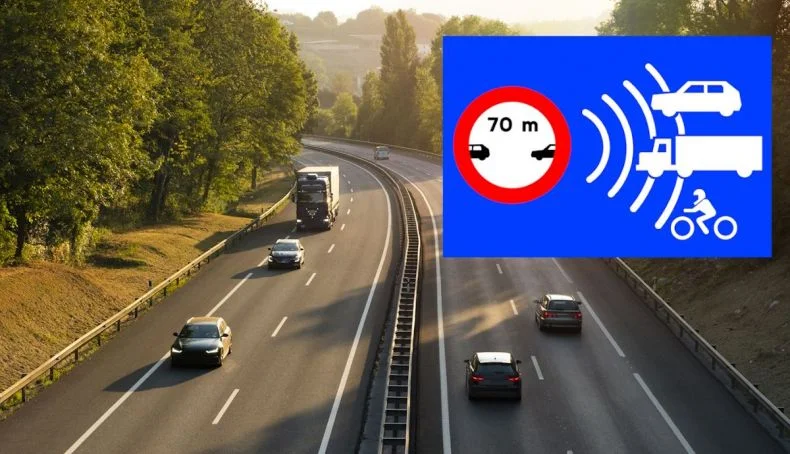
Spain’s S-991f sign alerts drivers to automated checks of the space between vehicles. Its blue background and detection waves may resemble a speed camera warning, but the system monitors following distance. For freight and fleet operators, the practical point is that compliance depends on leaving room to stop safely, not simply observing the posted speed limit.
What the S-991f sign identifies
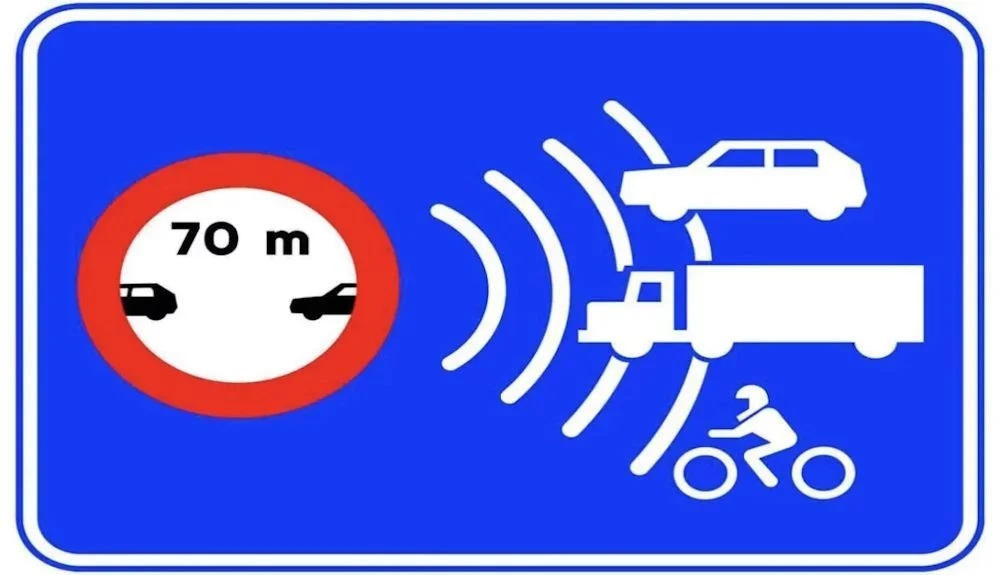
The S-991f belongs to the S-991 family, which indicates automated traffic controls. Its vehicle symbols and detection waves identify a system checking the gap between vehicles. A sign may appear within a larger panel or alongside additional information specifying the section, affected lanes or minimum distance.
The sign entered Spain’s official traffic sign catalogue under Royal Decree 465/2025, which took effect on 1 July 2025. It makes an existing duty more visible; it does not create a new offence. The sign also doesn’t always specify a 70-metre gap. Drivers need to read the number, if one is displayed, and follow any accompanying panel.
Similar symbols are used for different types of monitoring. The S-991a indicates speed control, while the S-991c concerns red-light monitoring. The S-991f itself indicates distance checks, so drivers should identify the precise sign rather than assume every blue monitoring panel is a speed camera.
The required gap depends on conditions
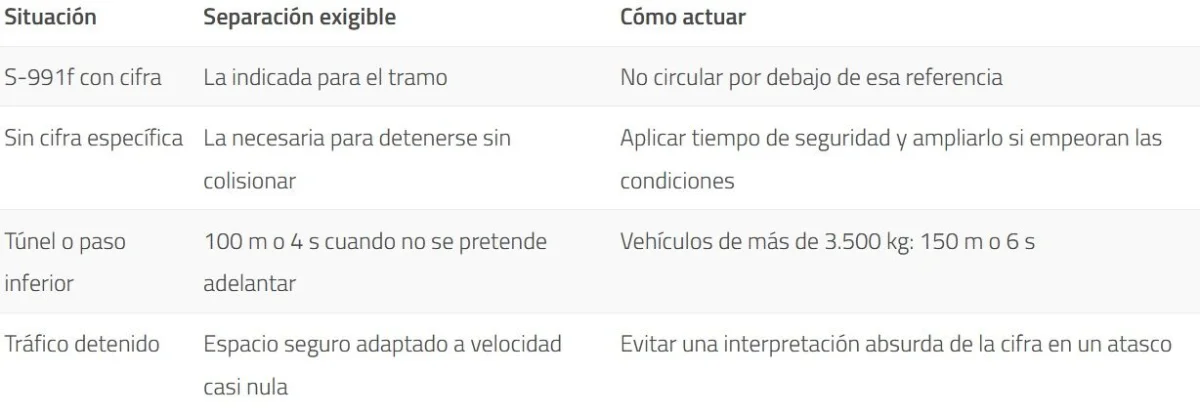
Article 54 of Spain’s General Traffic Regulations requires drivers to leave enough space to stop if the vehicle ahead brakes sharply. The appropriate gap depends on speed, road grip and braking capacity. There is no universal 70-metre rule for every car, speed and road.
Rain, ice, worn tyres, poor visibility and a heavier load can all call for more room. A number shown on an S-991f installation applies to the marked section, but it doesn’t mean that distance is always sufficient in adverse conditions. Drivers must still allow for the road and vehicle conditions.
The usual penalty for failing to keep a safe distance is €200 and four points. The offence is separate from speeding, so a driver can be cited for following too closely without exceeding the speed limit. The sign itself does not automatically raise the penalty to €500 and six points. A more dangerous incident may be assessed differently based on the conduct, but any case must identify the offence alleged.
Where drivers may encounter checks
Automated distance monitoring is suited to roads and sections where equipment can observe vehicle spacing. Possible locations include motorways, dual carriageways, tunnels, access roads with frequent queues and points where rear-end collisions are a concern. There is no fixed national list that makes every overhead gantry a distance-control point. The installed signs and supplementary panels tell drivers which section or lanes are covered.
Installation of the revised sign catalogue is gradual, so the S-991f may not appear on every road. Its absence doesn’t remove the obligation to leave a safe gap. The road operator determines sign placement in view of its responsibilities and the characteristics of each section.
Practical ways to judge spacing
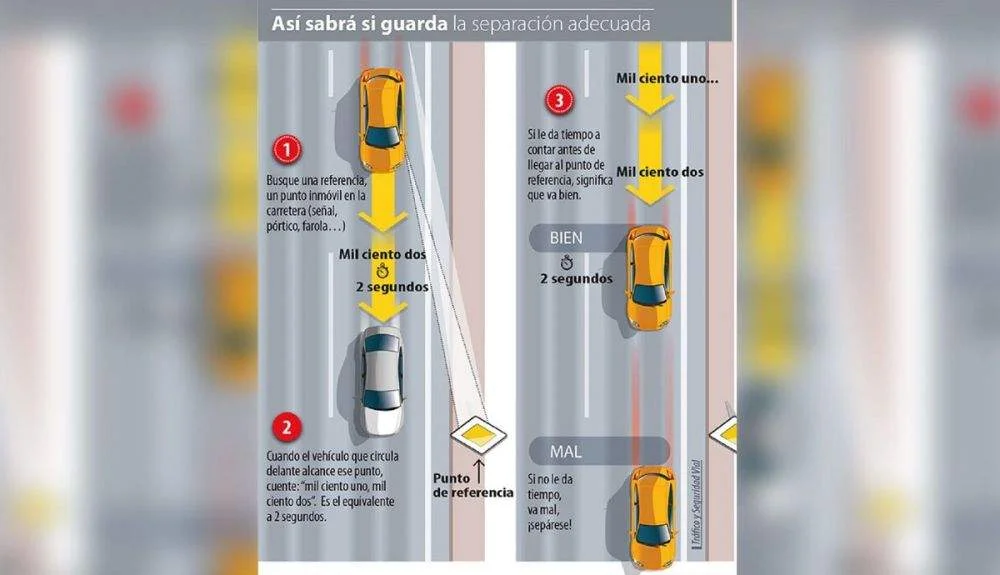
A two-second check offers a simple in-cab reference. Choose a fixed roadside feature and start counting “one thousand and one, one thousand and two” when the vehicle ahead passes it. If your vehicle reaches that point before the count ends, ease off and increase the gap. In rain, fog, darkness or on a slippery surface, allow three or four seconds instead.
This timing method is a guide, not a substitute for a distance specifically posted at a control point. Another rough estimate uses the square of the speed’s leading digits: at 90 km/h, 9 multiplied by 9 gives 81 metres; at 120 km/h, 12 multiplied by 12 gives 144 metres. It is a cautious reference for normal conditions, not a universal legal minimum. Poor grip or visibility can require more space.
What automated monitoring involves
Monitoring equipment may combine images and measurements to assess the interval between vehicles and record a registration plate. A resulting notice must identify the incident, location and other details required by the sanctioning process. Automated operation does not mean every brief reduction in spacing necessarily results in a penalty; the evidence must connect the reported conduct to the vehicle cited.
Distance monitoring and speed monitoring concern separate duties. Drivers need to comply with the road’s speed limit while also leaving the space required to stop safely. A sign may warn of monitoring, but the underlying duty comes from the relevant traffic rule or control sign.
When another vehicle moves into the gap
If a vehicle merges in front, ease off gradually and rebuild the following distance. Staying close to discourage a driver from entering increases risk and doesn’t excuse unsafe spacing. Avoid a sudden lane change unless there’s enough room to move safely.
In dense traffic, the gap should reflect the speed and conditions while leaving time to react. Judging it with a fixed roadside reference and a seconds count is more practical than repeatedly trying to estimate metres. The aim is to maintain a steady buffer before reaching a monitored section, rather than braking sharply beneath a gantry.
What drivers should take from the sign
The S-991f is not a speed camera warning: it marks automated checks of vehicle separation. Read any distance or lane information on the sign, maintain a gap that allows for a sudden stop, and increase it when weather, visibility, road grip or load make braking less predictable. The usual penalty for an unsafe gap is €200 and four points, but the essential operational measure is a following distance that helps prevent a collision.


