Thursday, October 15, 2026 · Supply Chain Tech
Forecasting, Stock Data and Order Workflows Shape Supply Chain Execution
Noted by Henrieke Wagenvoort · 906 reads
At SCE Day, four technology providers showed how forecasting, accurate stock data and captured operational knowledge can improve order execution.
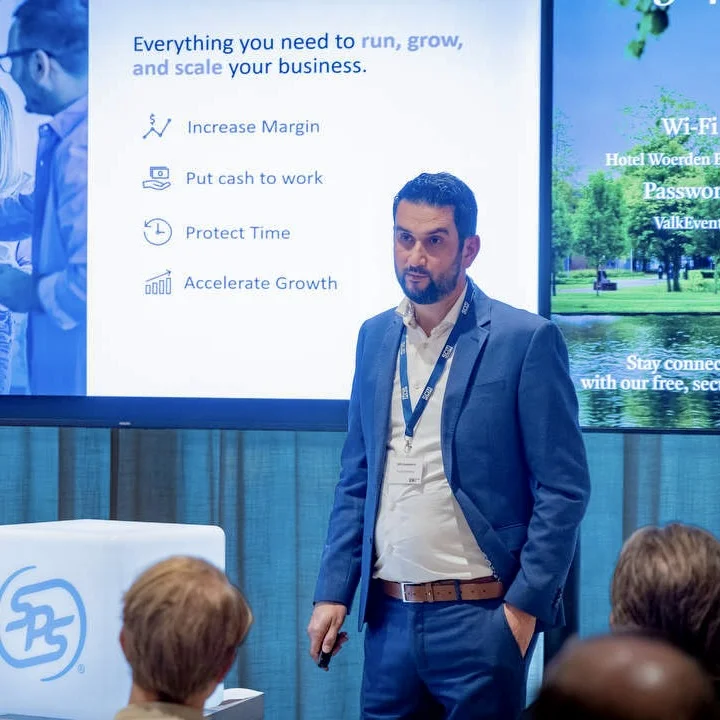
Supply chain execution depends on decisions made well before an order reaches a warehouse. Forecasts determine what companies buy and hold; reliable stock data guides replenishment; and accurate information between trading partners helps orders and invoices move without avoidable delays. At Supply Chain Media’s first SCE Day, Remira, Slimstock, SPS Commerce and MintIQ presented technology aimed at those connected problems, with artificial intelligence increasingly part of the toolkit.
The presentations pointed to a practical challenge: companies may have systems in place but still rely on spreadsheets, manual workarounds and employees who carry essential process knowledge. Improving execution means addressing those foundations alongside adopting new software.
Forecasts set the conditions for fulfilment
Remira’s Johan van Hemert, Benelux country manager, made demand forecasting the starting point. Expected sales shape inventory levels, replenishment timing and purchasing from suppliers. Forecasts cannot remove uncertainty, he said, but making it visible can help companies understand and manage it.
The cost of a forecast error shows up across operations. A forecast that overstates demand can tie up working capital, increase storage costs and leave a business with dead stock. Underestimating demand can lead to stock-outs, lost sales and urgent work to deal with the shortfall. Forecasting accuracy therefore affects both the availability of goods and the resources needed to hold them.
Van Hemert cited office supplies distributor Soennecken, which tested Remira’s AI forecasting tool alongside its traditional tool. In the comparison, the AI system detected a decline in demand without requiring parameter changes. It also identified seasonal patterns without needing the model to be trained for those patterns. Van Hemert said transparency and comparison with existing results are ways to build confidence in AI forecasts.
Stock decisions need sound inputs
Slimstock’s Jan Kraaijeveld shifted the discussion from forecasting to inventory management. The core choices are when to order and how much to buy, with managers weighing the expense of holding stock against the costs of placing orders repeatedly.
Those decisions also sit between competing business priorities. Sales teams may favour higher inventory to support availability, while finance teams seek to release working capital by carrying less. Kraaijeveld said the discussion can stall because those teams measure the issue in euros, while stock managers need instructions in units: which products to stock and in what quantities.
Before choosing reorder points or order sizes, companies need to establish that the product range and underlying records are dependable. Kraaijeveld urged managers to check how many different items they stock and can buy from suppliers, and to verify prices, lead times and minimum order quantities in their ERP system. Incorrect values can undermine a replenishment decision even when the planning process itself is sound. The operational takeaway is straightforward: a tool can only guide purchasing as well as its product and supplier data allow.
Disconnected trading systems carry a cost
SPS Commerce, which connects retailers and suppliers digitally, focused on the data exchanged between trading partners. Farid Talhaoui, the company’s Benelux country sales manager, described how bespoke integrations can create a succession of IT projects. Once one connection is working, another customer or supplier may require a different one. The resulting complexity can slow processes and introduce errors into transferred data.
Those errors can affect day-to-day transactions. An order may arrive late, or an invoice may be paid late because information failed to transfer correctly. Talhaoui said the costs can reach 5 per cent of turnover for a company and, for some businesses, amount to half their margin. The figures were presented as the potential impact of poor data, rather than as a result reported for a named company.
SPS Commerce’s AI agent, Max, monitors orders, shipments and invoices, responds to questions about trading partners and flags potential risks. Employees can ask it about a customer’s requirements or when a first order might be expected after a contract is signed. The example illustrates how a shared view of trading information could help teams prepare for incoming work and spot issues across transactions.
Capturing the knowledge behind orders
MintIQ founder Hylke Sluis described cases where execution breaks down for reasons that are highly specific to a site or customer. A lift manufacturer told him that, on busy days, it sometimes ran out of indoor space and stored products outside. Staff could forget to cover the machines before rain. Sluis said the immediate request was for an alert when the chance of rain exceeded 20 per cent, rather than a demonstration of an AI system’s broader capabilities.
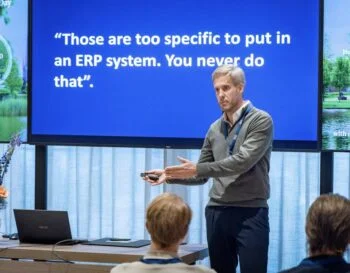
At a food sector logistics provider, Sluis saw sticky notes on computer screens with instructions such as keeping a particular batch away from a particular customer. Those notes pointed to another gap: order management often depends on information spread across an ERP system, customer service spreadsheets and the experience of individual employees.
MintIQ’s system uses AI to gather knowledge from sources including emails, memos and spreadsheets, then make it available to users making routine decisions. Sluis said users can describe in their own language how the system should behave and what actions it may take. The system is also designed to explain what it plans to do or has done. That visibility matters when software is drawing on informal rules that employees have developed through experience.
The four presentations put preparation at the centre of execution: forecast demand, maintain reliable product and supplier records, keep trading data flowing, and record the operational knowledge that might otherwise stay in a spreadsheet or with one colleague. AI can support those tasks, but the examples show that its value depends on whether teams can inspect its output and apply it to the decisions that keep goods moving.
 Read more about Remira, Slimstock, SPS Commerce and MintIQ.