Wednesday, September 23, 2026 · Trucking & Freight
2027 Freight Budgets: Shippers Seek Flexible Rates and Better Forecasts
Noted by Bjorn Vang Jensen · 762 reads
Shippers are weighing indexed rates, tighter surcharge terms and rolling forecasts as they prepare 2027 ocean and air freight budgets.

For shippers preparing 2027 freight budgets, the hard part isn’t choosing a single rate assumption. It’s explaining how costs could change as volumes, lane mix, market prices and other factors shift through the year. Discussions at Xeneta roundtables in Atlanta, Houston, London and Cologne point to a wider procurement challenge: annual tenders don’t match a market that keeps moving.
Participants shared concerns about service reliability, surcharges, contract structure, allocation performance and the limits of current forecasting. Singapore and Paris were due to host later sessions.
Reliability needs a price and a shared definition
Shippers don’t use one common definition of “on time.” In Houston, participants considered a delay of up to five days acceptable on a six-week Asia–US lane, while treating ten days of variation as normal. The discussion in London highlighted a related measurement problem: what counts as a tight schedule for one shipper may be loose for another.
A simple on-time percentage can also hide the size and pattern of delays. Two lanes might each be on time 85% of the time, yet have very different outcomes for the late 15%. On one lane, late arrivals could be a day or two behind schedule; on another, delays could range from two days to four weeks. The percentage alone doesn’t show whether a shipper needs extra safety stock to cover that variability.
Without a shared definition and lane-level data, reliability risks becoming a negotiating point rather than a service commitment. Some demand planners have built large inventory buffers to compensate for uncertainty, adding cost. Shippers at the roundtables raised the Gemini alliance, formed by Maersk and Hapag-Lloyd, as both an example of achievable reliability and a benchmark for other carriers.
But the alliance’s reported results have varied. Sea-Intelligence tracked Gemini schedule reliability across all arrivals at 89.5% in December/January 2026, then 79.1% in January/February and 76.8% in February/March. Xeneta’s analysis put Gemini roughly 39 percentage points ahead of the next-best alliance group even at its lowest point in the first quarter of 2026. Participants also pointed to anecdotal evidence that results fall when performance is measured end to end rather than between hubs.
That variation helps explain why procurement teams want reliability figures written into contracts at the lane level. If carriers cite service quality to justify a surcharge or rate increase, shippers want evidence that the service has improved.
Surcharges are testing shipper trust
Across the roundtables, surcharges were a leading source of frustration. Participants said carriers often don’t explain what triggers a charge, how they calculate it or what conditions would reduce or remove it. One shipper said several ocean carriers couldn’t forecast the next quarter’s bunker adjustment factor when asked, because they didn’t understand their own calculation well enough to do so.
Xeneta tracking shows the Far East–Mediterranean surcharge rose 113% between February and July 2026, while bunker fuel prices stayed flat. The gap raises questions about how closely the charge reflects the fuel costs it is meant to cover.
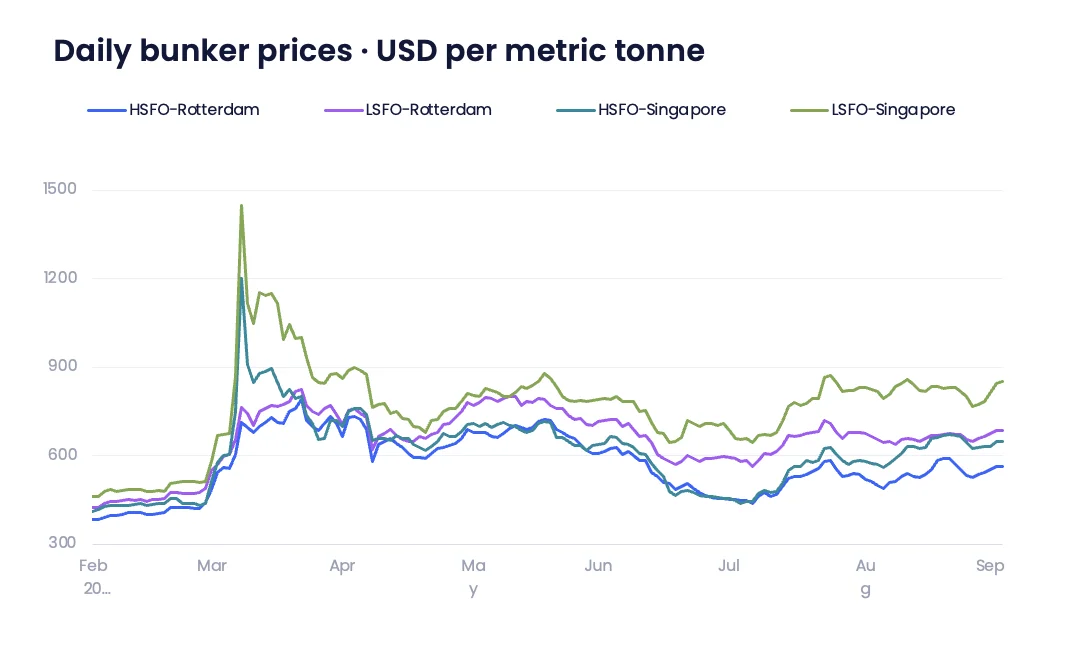
Marine bunker fuel prices, Feb–Sep 2026.
Shippers described a similar lack of consistency in Panama Canal transit fees, with carriers charging up to three times as much for the same transit and no consistent basis for the difference. Some companies have shifted to monthly bunker billing, accepting a slightly higher cost in exchange for fewer surprises. Others have negotiated one all-in rate to avoid disputes over separate charges.
Contracting is moving beyond the annual tender
Index-linked contracts have not gained traction as quickly as some expected. Shippers said carriers may sign an indexed agreement, then seek to opt out when the index moves against them, preferring guaranteed volume to a floating rate they can’t control.
Shippers also cited three concerns: costs could exceed what a fixed rate would have produced; they could miss a favorable moment to tender; and their internal processes may not be ready to manage index-based pricing. Yet in a seller’s market, many contracts already behave like indexed agreements without being described that way.
Several shippers in Atlanta, Houston and London are testing a hybrid approach: fixing about 80% of volume at long-term rates and indexing the remaining 20% to cover volume above the minimum commitment. Participants expect the balance to shift toward indexing or more frequent mini-tenders as procurement teams address the operational hurdles.
A recording discusses shipper resistance to indexing.
Allocation performance needs attention between tenders
The tender award is only one point at which procurement can affect freight spend. Teams want to know throughout the year which carriers should receive volume, what risks sit within an award, whether the planned carrier mix is being used, why actual costs differ from budget and what evidence could support a renegotiation.
In Houston, participants identified allocation adherence as a more immediate concern than transit time. Carriers don’t always honor confirmed bookings consistently, while blank sailings can reduce allocations even under signed contracts. Shippers want to track changes between awarded volumes and actual bookings before the next tender, rather than learn about service gaps from a schedule report afterward.
Make forecast variance explainable
All the represented teams budget freight across departments, and all want a longer view. Most said they can’t forecast with confidence beyond three months; some are fortunate to achieve six months, while their target is a rolling 12-month forecast.
As one participant put it, “Half the time I spend forecasting. The other half of the time I spend explaining why the forecast is wrong.” Another said, “If we knew the numbers, we’d be in the Bahamas.” The goal isn’t certainty. It’s a process that lets teams explain what changed while the year is underway.
Participants described splitting budget variance into four sources: volume, trade lane mix, price and macro effects. Volume captures changes in the number of containers shipped. Lane mix tracks how activity moved across the network, even if total volume stayed the same. Price separates tender outcomes from market movements, including surcharges. Macro effects account for currency exchange and inflation rather than freight costs.
This structure turns a general budget miss into a traceable explanation, such as $2.4 million in price effect divided between tender results and market movement, supported by lane-level data. Teams that use this approach review the breakdown monthly or quarterly against current market data, rather than waiting for the next annual tender.
Budget for a range of outcomes
Roundtable participants and Xeneta’s analysis pointed to ocean and air rates that could be flat to modestly higher in 2027. The range depends on different market factors for each mode.
For ocean freight, shippers are watching whether Red Sea and Suez routing returns to normal, whether the 2025–26 demand surge fades or gives way to new front-loading, and whether new vessel deliveries coincide with capacity returning from Cape diversions. For air freight, the variables include Gulf hub capacity, the durability of demand for freighters tied to artificial intelligence, and how quickly e-commerce volumes respond to changes in the rules that affect them.
Shippers had expected a Suez reopening to soften rates this year, but spot rates out of the Far East instead rose to roughly $6,000. That surprise left participants wary of a flat-to-firmer 2027 outlook without accounting for potential changes around the Red Sea or Panama Canal. A defensible budget should therefore show a range against each swing factor and explain why the forecast differs by lane.
The practical task for procurement is to give finance a range it can follow, with assumptions that can be revisited as market conditions change. Xeneta says its Lens service supported roughly 40 tenders and 541 advisory engagements in 2026, covering preparation before requests for quotes, bid scoring and monthly market guidance. The company reports that customers using the service beat the long-term market average by 23% and reduced the gap between opening bids and final allocations by an average of 18 percentage points.