Thursday, September 10, 2026 · Trucking & Freight
10 Logistics Technology Trends European Carriers Should Plan for in 2027
Noted by Ralitsa Dimitrova · 828 reads
Rising fuel costs, driver shortages and empty running put fleet margins under pressure. Ten technology shifts could help carriers plan capacity and protect profit.
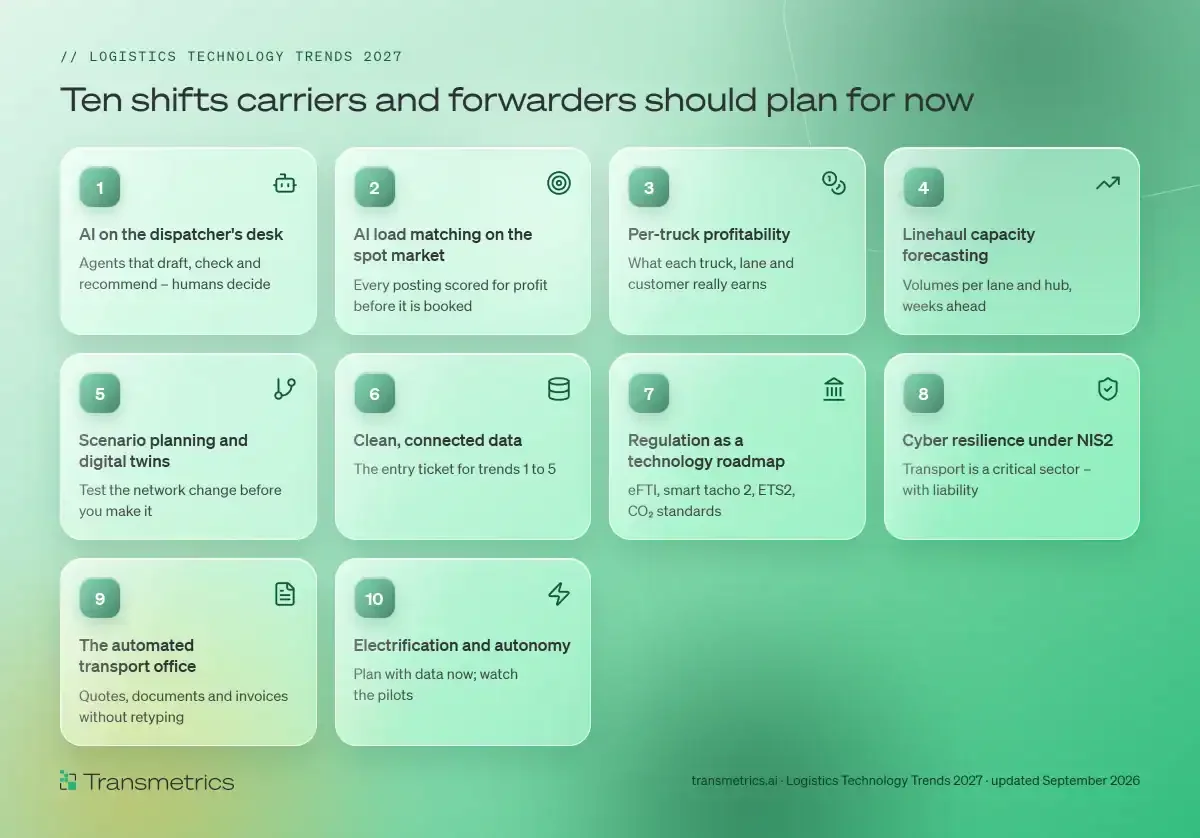
European carriers are heading into 2027 with a sharper cost problem: fuel is dearer, drivers are scarce and too many trucks still run without freight. The response is increasingly found in software already close to daily operations, from load selection at dispatch to trailer planning across parcel networks.
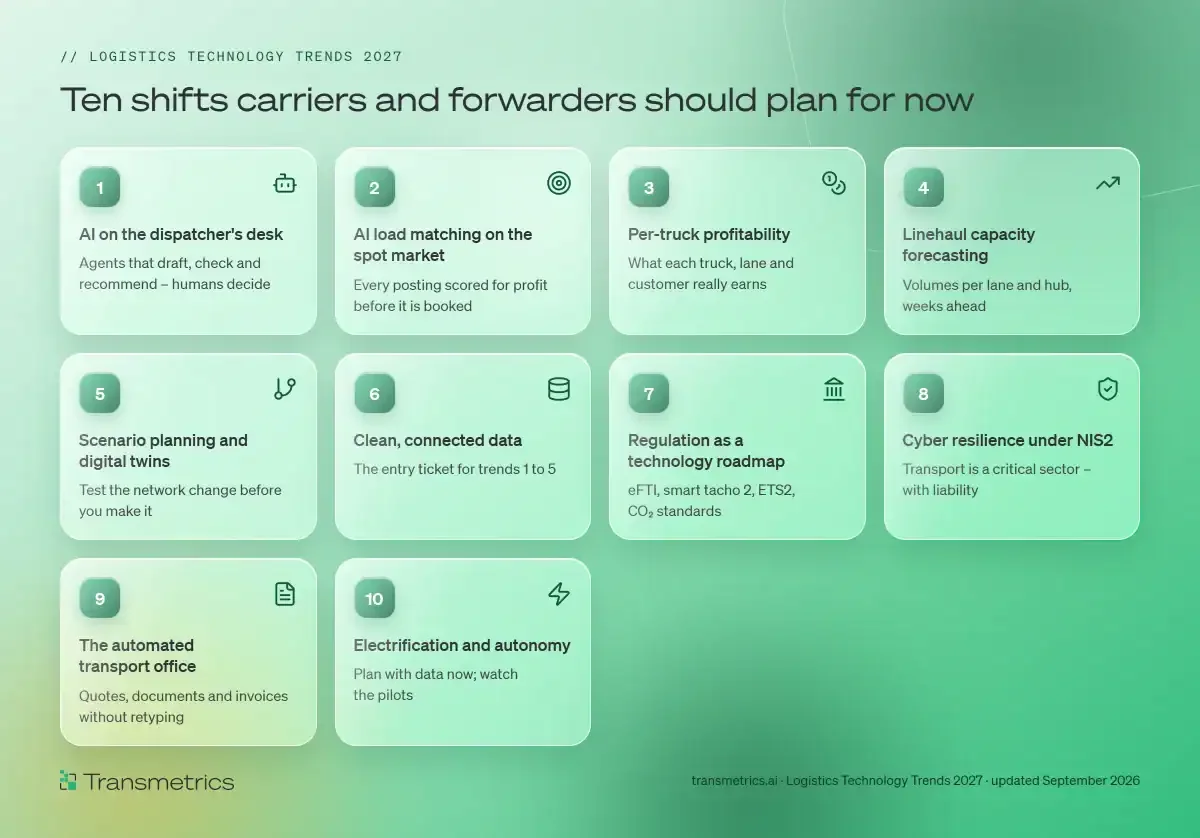
In the second quarter of 2026, EU diesel averaged €1.94 a litre, up 27% from a year earlier. The Upply, Ti and IRU road freight benchmark put the contract rate index at 148.0, up 7.9 points on the quarter, and the spot index at 146.8, up 14.6 points. Road freight volumes between major European economies fell 1.6% year on year. Europe also had roughly 502,000 vacant truck driver positions, while 21.6% of EU truck kilometres were driven empty in 2024.
Those figures put margin and utilisation at the centre of fleet planning. The technology choices that matter are the ones that help carriers choose better loads, match capacity to demand, and see what each truck, lane and customer actually earns. The sequence matters too: several of the tools below rely on clean data drawn from the systems fleets already use.
1. AI becomes part of the dispatcher’s daily tools
AI is moving from standalone trials into the workflow of the dispatch office. Gartner’s supply chain technology trends for 2026, published on 30 June 2026, highlighted agentic AI, systems of cooperating agents and intelligent simulation. In practical terms, software can review incoming load offers against the fleet plan, rank suitable options and explain the reasons behind its recommendations.
For a carrier with 40 to 500 trucks, that can make AI useful without requiring an in-house team to build and maintain models. The software can draft, sort and flag; the dispatcher can still decide whether to accept a load or move a driver. Fleets should set those decision boundaries before deployment. Reordering a list might be safe to automate, while a booking decision may need a person’s approval. A recommendation also needs a clear explanation: if the dispatcher can’t see why a load ranks highly, it will be hard to rely on the result.
That makes the first measure of a useful system operational rather than technical: does it reduce time spent reviewing offers, and does it give dispatchers a better basis for a decision? AI in logistics, dispatch support and tool selection are all tied to that test.
2. Load matching moves beyond manual exchange searches
When costs drive rate movements, selecting the right load can matter as much as negotiating the rate. Many dispatch offices still scan Timocom, Trans.eu and email offers one by one, judging them by the posted rate per kilometre and a planner’s experience. That approach can miss the full cost of repositioning a truck or the effect a load has on the next trip.
AI load matching brings those details into a ranked view. A system can collect offers from exchanges and inboxes, estimate repositioning distance, tolls, fuel and driver time, then check the shipper’s history and whether a specific truck will be available. The result is an estimated profit per load before a dispatcher books it.
That changes where a planner spends time. Software can sort routine offers, while the planner handles negotiation, customer conversations and exceptions. For teams using a tool such as SpotLoad, the source describes an offer feed that combines exchanges and email, scores loads by profit per kilometre and network impact, and prioritises the strongest options. Fleets using it report saving three to four hours a week per planner. The product is aimed at European road carriers running 20 to 500 trucks; a trial option is available.
3. Profit per truck becomes a more useful monthly measure
Revenue per truck is familiar, but it doesn’t show whether that truck is making money after fuel, tolls, driver wages, maintenance and empty running are assigned to its trips. The same gap applies to lanes and customers. A customer can generate substantial revenue while requiring costly repositioning or leaving the return leg unproductive.
Eurostat’s 2024 figures put empty running at 21.6% of EU road freight vehicle kilometres: 25.8% for national transport and 12.6% for international transport. That makes empty legs a material part of the cost picture, rather than a small detail to leave out of a monthly review.
The underlying data is often already in fleet systems. Telematics, the transport management system (TMS), fuel cards and toll statements can be joined by vehicle and trip to show what a movement earned. That depends on accurate trip records, which is why the data work described in trend six matters. Once the figures are connected, managers can identify customers whose costs exceed their contribution, lanes that look profitable only because the return is missing from the calculation, and trucks that may be better repositioned than parked. Profitability analysis, telematics data and fleet planning can all support that view.
Transmetrics says its FleetMetrics product combines telematics, TMS, fuel card and toll data to calculate profit by truck, lane and customer, and flag repositioning opportunities. Carriers using it report up to €500 more profit per truck per month. That is a customer-reported result, not a guarantee for other fleets.
4. Forecasting turns to linehaul capacity
Parcel, postal and groupage networks have long forecast parcel volumes. The next step is using those forecasts to plan the trailers and departures needed on specific hub-to-hub lanes. A network that can estimate Thursday’s volume on each lane weeks ahead has more time to arrange the right equipment and subcontractor capacity, and less need to send half-full trailers during peak periods.
Speedy, DPD’s Bulgarian network, provides a reported example. The operation runs more than 700 vehicles and handles 16 million parcels a year. After introducing volume forecasting and linehaul optimisation, it raised utilisation on the lanes planned this way from 72% to 82% and reduced total cost by an estimated 7–9%. The source attributes these results to Speedy’s operations team’s measurements after the change.
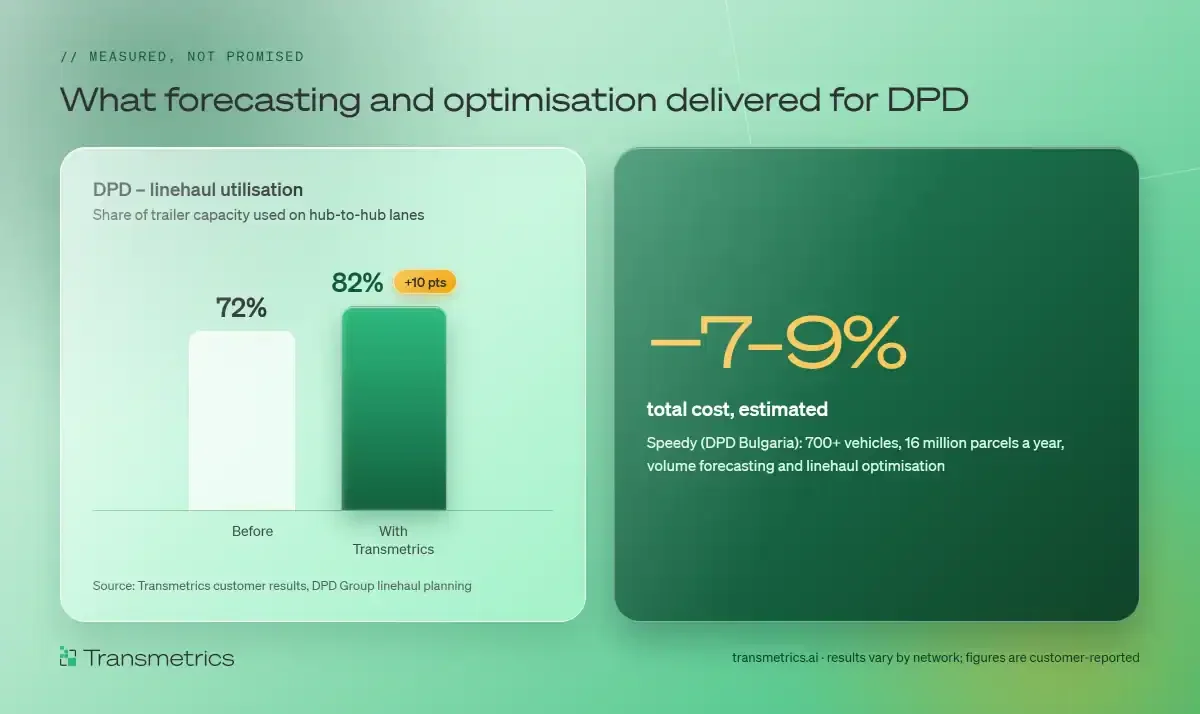
NetMetrics is described as a planning tool for parcel, postal and groupage networks. It forecasts volume by lane and hub, then plans trailers and departures against that forecast. It was also used in the Speedy example. For operations teams, the practical question is whether forecasts arrive early enough to change equipment, staffing or subcontractor plans.
5. Network simulation supports more frequent planning
A digital twin gives planners a model of a transport network that they can use to compare options before changing the live operation. They can examine the possible effects of closing a hub, adding a night departure, taking on a customer with 300 pallets a day, or assigning a corridor to electric trucks with a 350-kilometre range.
DB Schenker Bulgaria used this approach to compare network configurations for efficiency and resilience before adjusting its infrastructure and linehaul plan. The change described for 2027 is how often companies use simulation: instead of treating it as a project that comes around every few years, planners can run comparisons before peak seasons and major customer contracts.
That only works if the model reflects the real network. Historical records have to capture volumes, movements and costs well enough for a comparison to be useful. A simulation built on incomplete trip data can produce a confident answer to the wrong question. Scenario planning and the DB Schenker Bulgaria example both point back to the quality of the underlying information.
6. Connected data supports the other tools
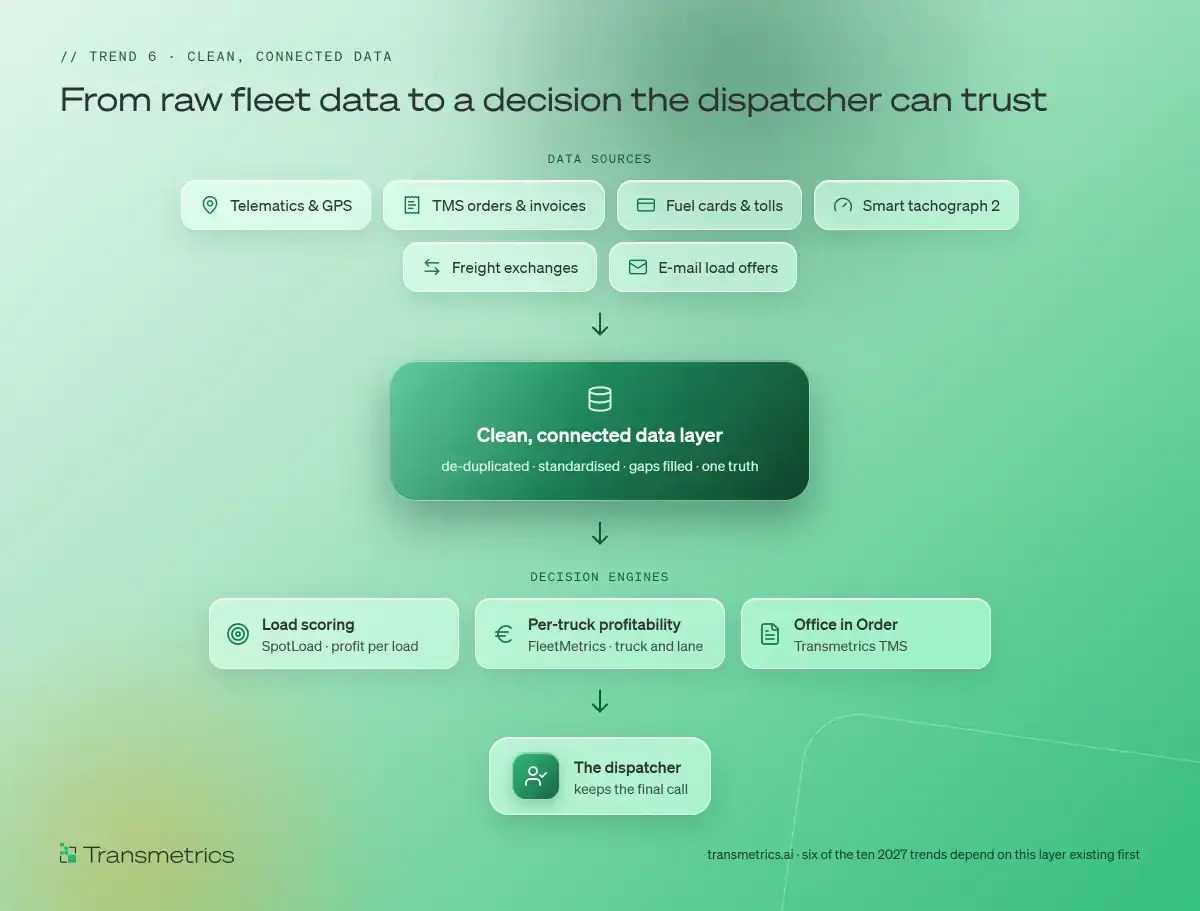
Fleet data is spread across GPS and engine systems, TMS orders and invoices, fuel cards, toll records, freight exchanges and email offers. Smart tachograph 2 also records border crossings and loading and unloading positions automatically. But having these records does not mean they can be compared. Each system may use different formats, and the underlying entries can contain duplicate customers, outdated driver records, mistyped postcodes or trips without a recorded empty leg.
Those gaps can undermine load scoring, profitability analysis, forecasting, network simulation and office automation. The source estimates that six of the ten trends depend on a clean, connected data layer. That layer needs to draw information from systems a fleet already has, standardise and de-duplicate records, and fill gaps from historical information where possible. Data quality, shared data formats, data management and fleet data practices are part of the same groundwork.
Before buying another planning tool, carriers should ask which systems it can connect to on day one. That question is practical: a tool that requires extensive manual re-entry may add work before it saves any. It also helps distinguish a usable product from one whose value depends on a separate, lengthy data project.
7. Technology plans must account for dated requirements
Several EU requirements carry fixed dates that can affect fleet systems and planning. Carriers should check how their TMS, telematics and document workflows handle each change before committing their 2027 budgets.
- Smart tachograph 2: Retrofit deadlines for heavy vehicles in international transport passed on 31 December 2024 and 18 August 2025. Since 1 July 2026, vans weighing 2.5 tonnes or more in cross-border transport also need the device. It records position at border crossings and loading and unloading points. Further detail is available from DAKO’s overview.
- eFTI from 9 July 2027: Under Regulation (EU) 2020/1056, each EU member state must accept freight transport information shared electronically through certified eFTI platforms from that date. Paper consignment notes remain permitted, but carriers may need their TMS to produce digital documents when customers request them. The European Commission’s eFTI information describes the framework.
- ETS2 from 2028: Carbon pricing on road transport fuel was moved from 2027 to 2028 in December 2025. The source describes the cost as reaching carriers through fuel surcharges, making fuel use and CO₂ per trip useful measures to track. CLECAT reported the revised timing.
- Truck CO₂ targets for 2030 and 2040: A March 2026 change gave manufacturers more flexibility on the 2025–2029 path while leaving the 2030 and 2040 reduction targets in place. The Council’s account of the change sets out the manufacturer flexibility.
For each new system, fleets can ask whether it can use tachograph and telematics data, exchange eFTI-compatible documents, and report fuel and CO₂ by shipment. A supplier’s answer will show whether the product can support the workflows carriers are preparing for.
8. Cyber resilience reaches beyond the IT team
NIS2 classifies transport as a critical sector, and national implementation is in place. Germany’s implementation act took effect on 6 December 2025. For medium and large logistics companies, the requirements described in the source include recorded risk management, staged reporting of significant incidents and personal responsibility for senior management.
For fleets, shared passwords across TMS, telematics and freight-exchange accounts can create both an operational weakness and a compliance risk. The response does not need to begin with a dedicated security operations centre. Practical steps include multi-factor authentication on systems that handle orders or payments, tested TMS backups, written details from software vendors on where data is hosted and how it is protected, and an incident plan that staff have read.
Vendors should be able to provide evidence of their security controls. Transmetrics, for example, states that it holds ISO 27001 and ISO 9001 certifications. A fleet’s supplier checks should also cover access controls, hosting and backup arrangements, since those details affect the systems dispatchers and office staff rely on every day. The source’s account of Germany’s implementation gives the date and national context.
9. Transport office tasks become easier to automate
Every added truck can bring more quotes to price, orders to enter, consignment documents to chase and invoices to reconcile. Language models are now being applied to those routine tasks: extracting an order from a PDF or email, drafting a quote from a rate card, or matching proof of delivery to an invoice. Models trained on transport documents may be better suited to this work than general-purpose tools because they are built around the documents and terms used in freight operations.
The useful measure is how many trucks an office employee can support while maintaining service. If orders are captured once, documents are generated from existing data and invoices are raised when proof of delivery arrives, a carrier may be able to grow without adding a planner at the same pace. Automation should give office staff more time for work that needs judgment, while dispatchers gain access to the load recommendations described earlier.
Language models in trucking and transport office automation describe the capabilities. Transmetrics presents its TMS as a system for automating those workflows. The operational test remains straightforward: measure manual handling time and trucks supported per office employee before and after a change.
10. Electrification needs lane data; autonomy remains a watch item
Electric trucks are entering fleets, and the source expects that to continue as truck CO₂ targets remain in place. Carriers need to decide where the vehicles fit by using distance, dwell time and energy data. A truck that suits one lane’s range and schedule may not suit another, so fleet records can help match vehicles to work.
Improving utilisation also supports emissions goals. Every empty kilometre removed cuts fuel use and associated CO₂, and the source says it will also reduce exposure to fuel pricing under ETS2 once that change begins in 2028. That links electric vehicle planning to the work of improving load selection, truck profitability and linehaul utilisation. Sustainability planning therefore starts with the same operating data used to improve utilisation.
Autonomous trucking is at an earlier stage. In August 2026, DAF and Einride said they planned to integrate Einride’s autonomous system with DAF’s electric platform, with integration and commissioning planned for 2027. The source reported that no truck had received EU Level 4 type approval under Regulation 2022/1426 at the time. IRU expects 660,000 European drivers to retire by 2030, but driverless hub-to-hub operations are not an immediate answer for carriers planning next year. In the near term, reducing empty and poorly paid kilometres is a more direct way to make better use of available drivers. Details on the DAF and Einride plans and driver availability frame the longer-term picture.
Four steps to take before the 2027 budget is final
Start by connecting telematics, TMS, fuel card and toll records so managers can see costs and output by truck and trip. When assessing vendors, check which existing systems they can connect to immediately and how they handle incomplete records.
Next, choose one decision for AI support. Load selection is a practical starting point because the carrier can compare profit per load and planner time saved. Keep the dispatcher involved in the booking decision, and check that the system explains its rankings.
Then add profit by truck, lane and customer to the monthly management review. Use those figures to identify where costs sit and where utilisation can improve. Finally, ask each software supplier in writing about tachograph and telematics data, digital freight documents, fuel and CO₂ reporting, data hosting, access controls and backups.
For carriers, the sequence is as important as the individual tools: connect the records, improve one decision, measure the outcome and expand from there. Transmetrics offers a demonstration of its load matching, profitability and linehaul planning tools using a carrier’s own network data.
Frequently asked questions
What does logistics technology cover?
It includes the software, data and connected hardware used to plan and monitor goods movements, such as telematics, TMS platforms, freight exchanges and AI tools for load scoring, forecasting and network planning. In road freight, its value can be measured through empty kilometres, load profitability, office time per truck and document handling.
Which technology trends are most relevant to European carriers in 2027?
The main shifts are AI support for dispatchers, automated load matching, profit analysis by truck and lane, linehaul capacity forecasting, network simulation, connected data, systems prepared for dated EU requirements, cyber resilience, office task automation, and data-led planning for electric vehicles. The source also identifies autonomy as a technology to monitor.
How can a fleet of 40 to 500 trucks start using AI without a data team?
Begin with a single decision, such as ranking loads by estimated profit. Connect available telematics, TMS, fuel card and toll data, choose a tool that can work with those systems, and keep the dispatcher responsible for the final booking decision. Track profit per load and hours saved per planner before extending the work to truck profitability or linehaul forecasts.
What dates should carriers keep in view for 2027 and 2028?
Smart tachograph 2 requirements already cover heavy vehicles in international transport and, since 1 July 2026, vans of 2.5 tonnes or more in cross-border transport. Member states must accept electronic freight transport information from 9 July 2027 under Regulation (EU) 2020/1056. ETS2 is due in 2028, after being moved from 2027. The source also notes that truck CO₂ reduction targets remain for 2030 and 2040.


